God will never give you more than you can handle (reasonable? or reckless?)

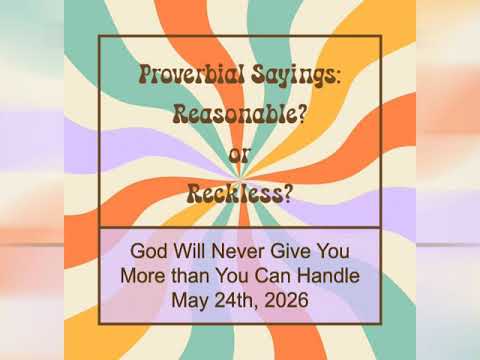
God will never give you more than you can handle (Proverbial Sayings: Reasonable or Reckless?) – May 24th, 2026
In the early years of Sculley Academy, every six weeks, in other words, six times a year, we would set aside our usual routine and spend an entire week doing a deep dive into something interesting. One of our most memorable unit studies involved humble toothpicks. Does anyone remember SciTrek? Ranked among the top science museums in the country, SciTrek, with its 140 interactive exhibits along with classes and camps, was a key part of cultivating wonder in each of the Sculley kids. It became very dear to our family, a place we frequented on monthly field trips and even some birthday celebrations. On one of our visits we heard about a toothpick building contest, designed to teach principles of engineering, structural design, and forces. Nine-year-old Peter and seven-year-old Jonathan lit up at the opportunity to build the strongest, lightest bridge they could using only standard wooden toothpicks and Elmer’s glue! So, for a week in February 2001 I guided Peter and Jonathan in researching, designing, and building their own bridges, aiming to maximize the load to weight ratio. On the day of the contest, they carefully cradled their creations and waited for their bridges to be tested by GA Tech scientists. Those judges weighed each bridge and placed it on a finely calibrated testing rig. The rig incrementally added weight, continuously displaying the load the bridge was bearing. A little bit more weight, more compression, more pressure … until suddenly … smash, their bridges snapped, shattered, and scattered all over the floor.
Our pastoral care and leadership team selected each of the sayings in our current sermon series, Proverbial Sayings: Reasonable? or Reckless? precisely because these sayings are repeated often by many in our culture, and by many Christians. The sheer repetition of things like proverbial phrases makes them familiar, and we tend not to question things that feel familiar, especially when we have heard them repeated by many people over a long period of time. A 1977 joint study at Villanova and Temple Universities identified a phenomenon known as the illusory truth effect, which is the human tendency to believe false information to be correct after repeated exposure. This is why it is so important to assess truth based on more than just our feelings! We need to apply all the tools we have available: we observe reality with our senses, we use deductive reasoning to make logical inferences, we apply our intellect and reasoning to understand foundational truths, and, most importantly, we obey the objective standard of divine law. We do this by knowing and following Jesus Christ, who the incarnation of truth; by being guided by the Holy Spirit; and by staying rooted in God’s unchanging character as revealed in the Bible.
JR, Tamera, and Bart did an excellent job examining the first three sayings in this series. Some of the proverbial sayings in this sermon series tilt more towards reasonable. Then along comes today’s saying: “God will never give you more than you can handle.” The only thing I find reasonable about this saying is that it acknowledges that limits exist to what we can handle. Other than that, even though many well-meaning people repeat this phrase, it is actually quite reckless because it does not reflect the character or heart of God for God’s beloved image bearers. I wonder how much damage has been done by careless repetition of this seemingly well-intended proverbial saying.
The phrase “more than you can handle” refers to a situation, task, or amount of stress that exceeds your ability to manage, cope with, or endure. We might have seasons in our lives or observe seasons in other people’s lives where it feels to us like more weight, compression, and pressures keep getting added until eventually, smash, lives get snapped, shattered, and scattered. But is this what God is like, some kind of unobserved researcher conducting experiments on us to see what we can handle, what stresses we can absorb, what loads we can bear?
Whether we like it or not, all humans are tested. Even Jesus. The Bible tells us that Jesus “in every respect has been tested as we are, yet without sin” (Hebrews 4:15). He was tested in the areas of self-preservation, spiritual presumption, shortcuts to glory, societal rejection, religious scrutiny, betrayal, and abandonment. Through it all, Jesus remained faithful to God and the ministry he had been given, even in the face of the suffering that awaited him on the cross when he would lay down his life in self-giving love for the sake of the entire world. Jesus completely submitted himself to God’s will, even in the face of deep anguish, cruel torture, and certain death.
If Jesus had given in to any of these tests, it would not have revealed the truth about God. Remember, Jesus said of himself, “I am the way, and the truth, and the life” (John 14:6). God does not arbitrarily rescind natural laws to put on a display of power. The proverbial saying “God will never give you more than you can handle” makes a false promise. God does not promise to rescue us from everything that is too much for us to handle. God is not our genie, our pet, a vending machine, or an idol whom we can direct or manipulate with incantations or incentives, declarations or decrees, fasting or formulas. The Bible and church history provide story after story of people who lived and died with more than they could handle. In today’s world, our own community, and our own lives, plenty of us are struggling at any given time with more than we can handle.
Some people think that this proverbial saying comes from 1 Corinthians 10:13, which sounds comforting on the surface – “No testing has overtaken you that is not common to everyone. God is faithful, and he will not let you be tested beyond your strength, but with the testing he will also provide the way out so that you may be able to endure it.” We need to be careful not to make false assumptions by pulling Scriptures out of context. This verse is in a passage in which Paul is warning the church at Corinth to flee from the worship of idols and to run away from the temptation to rely on things other than the faithfulness of Christ. The promise that “God will provide the way out” does not mean that God will remove temptations or remove us from temptations, even when those temptations are more than we can handle.
Let’s look at two examples from the Bible.
The first example is from the Old Testament. About 1200-1400 years before Jesus of Nazareth, a baby was born, a descendant of Jacob, whose sons had all moved to Egypt. By the time of this baby’s birth, these descendants, the Israelite people, had, according to the Pharaoh at that time, grown “more numerous and more powerful” than the Egyptians. Because of that, as Exodus 1:14 tells us, “the Egyptians became ruthless in imposing tasks on the Israelites, and made their lives bitter with hard service.” Then, horrifyingly, the Pharaoh ordered first the midwives and then all of the people to throw every male Hebrew baby into the Nile River. This baby’s birth mother hid him for three months, but, long story short, God saved his life, and he was adopted by the Pharaoh’s daughter, who then named this adopted grandson of Pharaoh “Moses.” Exodus 2:11 tells us that “one day, after Moses had grown up, he went out to his people and saw their forced labor. He saw an Egyptian beating a Hebrew, one of his kinsfolk.” We might wonder how Moses knew he was a Hebrew, an Israelite. Firstly, his birth mother nursed him until “he grew up,” referring to his weaning which was at that time celebrated around a child’s third birthday. One of our granddaughters is only two years old and on an exponential growth curve of understanding and learning. She already knows so much about her identity, family, and culture, and knows which language to speak and even translate depending on who she’s with. Moses’s mother would have certainly given been highly motivated to give her son a strong cultural, religious, and familial foundation, especially knowing that in just a short time, she had to hand him over to Pharaoh’s daughter. Secondly, even after his adoption, Moses’s birth family remained a part of his life and identity. Thirdly, Moses carried in his body a visible mark of God’s covenant with Abraham, his circumcision, something not practiced by Egyptians. Even though Moses likely dressed, spoke, acted, and walked like an Egyptian, he knew who he was. Even though he was raised as an Egyptian prince in a position of royal privilege, Moses knew that his primary identity was that of an Israelite of the house of Levi. So, when Moses saw an Egyptian beating one of his Hebrew kinsfolk, as Exodus 2:12 tells us, “he looked this way and that, and seeing no one he killed the Egyptian and hid him in the sand.” It seems clear that Moses was faced with far more than he could handle, and his choices that day catalyzed some major snapping, scattering, and shattering, just like one of those toothpick bridges. The consequences were huge: 40 years of exile for Moses, and 40 more years of brutal oppression for the Israelites. And yet, Moses remained God’s choice of prophet, deliverer, and lawgiver and the one to whom God revealed God’s name YHWH, “I am who I am.”
The second example is from the New Testament. Jesus gave his first twelve disciples far more than they could handle. Let’s look at just one example. In Mark 6, we are told that “a great crowd” went around the Sea of Galilee to arrive ahead of where Jesus and his disciples would land their boat. After the disciples tell Jesus how late it was and how hungry everyone must be by now, Jesus simply instructs them, “You give them something to eat.” “But, Lord, God promised to never give us more than we can handle.” Can you picture the look on Jesus’ face if any of them had said that? Clearly, Jesus gave them far more than they could handle on their own. Have you ever been in a situation where even two or three people who are standing right in front of you are depending on you to do something that is beyond your own capabilities and resources? That can be a lot of pressure! Imagine what was going on that day. Thousands and thousands of hungry and tired people were gathered there. Demographic research tells us that over 90% of them were extremely poor. They had no financial margin – if they didn’t work that day, they didn’t eat. Imagine the pressure of that situation, when you and your buddies, all of you as hungry and tired and poor as everyone else in this great crowd, were told by God in the flesh to feed them yourselves. The key here is that when Jesus tells his followers to do something, it will certainly be more than they can handle, and God will provide whatever is lacking. And that’s exactly what happened. In retrospect, it might seem like an easy enough test because it ended with a miracle. After Jesus blessed the five loaves and two fish they had on hand, the disciples started handing it out, and, incredibly, “all ate and were filled; and they took up twelve baskets full of broken pieces and of the fish.” If Jesus – God in the flesh – had not given them more than they could handle, they would have missed out on participating in this miracle that has inspired and encouraged untold multitudes countless times since that day.
The problem of evil, also known as the problem of suffering, is the philosophical question of how to reconcile the existence of evil and suffering with the notion of a God with maximal power, maximal goodness, and maximal knowledge. This is a big problem and a hard one. Why does God test us or allow us to be tested? Sometimes we think we understand a little bit about that, and then something comes along that makes us realize that, to paraphrase Socrates, “the only thing I know is that I know nothing.” Suffering brings up so many unanswered and unanswerable questions. Losses, grief, health crises – why? Financial upsets, job changes, major life transitions – why? Lying, bullying, injustice – why? Broken trust, betrayal, abandonment – why? Nineteenth century theologian Søren Kierkegaard asserts that “to be a human being, to live here in this world, is to be tested” by God – not on our achievements, but on our obedience.
In the face of life’s difficulties, which includes evil and suffering, we are all tempted to respond poorly. I’m sure we can all relate to at least some of the responses in a list I found this week entitled “Top 10 Worst Ways to Handle a Situation” – complete avoidance, aggression and lashing out, bottling up emotions, procrastination, catastrophizing, substance abuse, social isolation, acting impulsively, deflection and blaming, pretending nothing is wrong. These are not helpful. And believing false promises about God is not helpful either. Whether it’s our own suffering, the suffering of loved ones, or the injustices we see all around us, we need to remember that God does not promise to get us (or anyone else) out of trouble.
When we hear someone say, “God will never,” alarm bells should be going off in us. Anyone who claims that they know what God will never do when it comes to God’s interactions with individual persons is claiming to know more than any human can know. We can know very important things about God, like God is all-loving, all-powerful, and all-knowing. What we do not know, and cannot know, are specifics about what God will or won’t do in the life of an individual person, whether we’re talking about ourselves or someone else. The Bible and church history are full of stories that defy categorization or classification. We are walking on thin ice whenever we try to come up with formulas to predict God’s actions in any given circumstance.
Sometimes life gets pretty intense. We might feel like we are the toothpick bridges being tested under great pressure. We might feel at times like we cannot take any more. We may have already had experiences in which we felt like our life just broke, leaving us snapped, shattered, and scattered all over the place. Bible teacher Caroline Albanese writes, “There are times when God puts us in situations that are legitimately impossible to handle on our own. We don’t have the capacity, the strength, or the resources. We feel the weight of the burdens taking us down. We’re swept under powerful waves and are gasping for air. We experience this in our own lives, and we read about it in Scripture … The gospel isn’t a message of self-sufficiency. It’s a message of self-insufficiency. It’s a message of reliance on Jesus for his all-sufficiency. Scripture is filled with stories of people in divinely ordained situations they surely couldn’t handle … We need Jesus not only to rescue us from our sins but to walk with us through difficult and overwhelming circumstances.”
From cover to cover in the Bible, God promises to be with us and help us in difficult times. Here are a few of those precious promises.
Psalm 46:1 – “God is our refuge and strength, a very present help in trouble.”
Psalm 55:22a – “Cast your burden on the Lord, and he will sustain you.”
Isaiah 43:19b – “I will make a way in the wilderness and rivers in the desert.”
Matthew 28:20b – “Remember, I am with you always, to the end of the age.”
Romans 8:38-39 – “I am convinced that neither death, nor life, nor angels, nor rulers, nor things present, nor things to come, nor powers, nor height, nor depth, nor anything else in all creation, will be able to separate us from the love of God in Christ Jesus our Lord.”
2 Corinthians 1:3-4 – “Blessed be the God and Father of our Lord Jesus Christ, the Father of mercies and the God of all consolation, who consoles us in all our affliction, so that we may be able to console those who are in any affliction with the consolation with which we ourselves are consoled by God.”
Whether or not God will give you more than you can handle is the wrong question. It’s not about what we can handle. Professor of Bible and Theology Eric J. Bargerhuff says that “the popular notion that ‘God will never give us more than we can handle’ is in reality a blatant falsehood—a lie. He will give us more than we can handle, and this for the express purpose of bringing us to the end of ourselves so that we realize our very life, breath, and sustaining power comes only from God all the time.”
The real question is, “Is there anything that God cannot handle?” God will never give you more than God can handle! And God chooses to work in and among and through us, the body of Christ. Our job is not to handle everything on our own. We can’t! There is a lot that each of us can and should do on our own. For example, we work on sustainable daily routines. We manage our personal finances. We learn to take better care of our bodies and our minds. We nurture relationships. We set healthy boundaries. We invest in our community. We practice forgiveness and generosity. But we are not able to do everything on our own. And so, it’s good to do regular pulse checks on ourselves to notice when we have more than we can handle. Sometimes God gives us difficulties. Sometimes God allows difficulties. There will be times when you will feel and know that you have more going on than you can handle. There will be times this year when you will have more than you can handle. There might be times this week or right now when you have more than you can handle. It’s good to believe. It’s good to do the best that you can. Our assignment is to remain faithful to Jesus by abiding in Christ in simple trust and obedience. By the power of the Holy Spirit, God will help us to endure.
And, whenever you have more than you can handle, remember that you are not alone. Always remember that almost all of the pronouns in the New Testament are plural! It’s not about me and God. It’s about God with us. God has given us one another. We are the body of Christ, not just church friends who make polite visits on Sundays. The body of Christ is a real family who demonstrate our love for God in the way that we love and care for one another in prayer and in practical ways. We look to God, and we lean on one another. God is faithful to supply us together with all that we need, whether wisdom, courage, encouragement, strength, or provision.
I want to close today by doing two practical steps that I hope will help us to respond in healthy ways to those things in our lives that are more than we can handle.
The first practical step is to learn to pray the Jesus Prayer that Christians have been praying since the 5th century. I have personally found this prayer very helpful whenever I am faced with anxiety, fear, despair, or anything that is more than I can handle. There are two simple steps, two short phrases spoken while breathing in and then out:
- “Lord Jesus Christ” (breathe in slowly, receiving a fresh infilling of God’s presence, peace, and power)
- “have mercy on me” (breathe out slowly, releasing everything that weighs down the heart and mind)
Let’s do this together three times. Each time you breathe in, receive a fresh infilling of God’s presence, peace, and power. Each time you breathe out, release everything that weighs down your heart and mind.
Lord Jesus Christ
(breathe in)
have mercy on me
(breathe out)
The second practical step is to pray for one another. I want us to gather in groups of 3 or 4. I want to invite each person to share one thing that is more than you can handle and then pray for one other. After everyone shares, then pray for one another. Dare to believe big. Dare to pray big. God invites us into places where it’s more than we can handle. The Lord is with us, the Lord is with you!