What doesn’t kill you makes you stronger (reasonable? or reckless?)

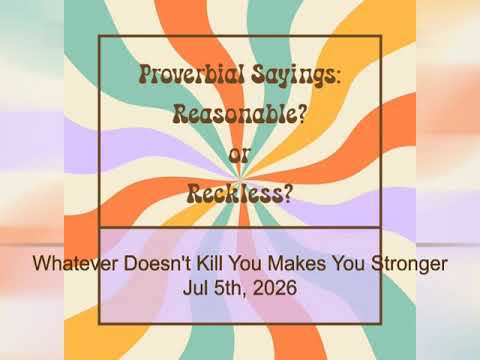
What doesn’t kill you makes you stronger (Proverbial Sayings: Reasonable or Reckless?) – Jul 5th, 2026
We all enjoy music in one way or another around here. How about we start with some music trivia – what do these songs from the last 50 years have in common? “I Will Survive” by Gloria Gaynor, “I’m Still Standing” by Elton John, “Stronger” by Kelly Clarkson, and “Roar” by Katy Perry. These songs are all known as anthems of resilience, universal soundtracks for overcoming adversity with messages of hope and endurance. One of them quotes today’s proverbial saying word for word – “Whatever doesn’t kill you makes you stronger.” Kelly Clarkson’s 2012 hit “Stronger” has become a massive source of encouragement to countless people with its combination of a catchy chorus, uplifting rhythm, and hope-filled lyrics about surviving adversity and emerging better on the other side.
But today’s proverbial saying didn’t originate with this pop rock song. It was first penned by 19th century philosopher Friedrich Nietzsche, in his autobiography, Ecce Homo: How One Becomes What One Is: “An intrinsically morbid nature cannot become healthy. On the other hand, to an intrinsically sound nature, illness may even constitute a powerful stimulus to life, to a surplus of life … He enjoys that only which is good for him; his pleasure, his desire, ceases when the limits of that which is good for him are overstepped. He divines remedies for injuries; he knows how to turn serious accidents to his own advantage; that which does not kill him makes him stronger …”
Before we dive deeper into this proverbial saying, Another trivia question for you – what do these people have in common? The Old Testament prophet Nathan, Aesop, Jesus, Jacob and Wilhelm Grimm? Only one of them is the Savior of the world, but all of them are storytellers who are known for telling vivid, memorable, relatable, short stories that convey timeless truths about the human condition in the form of parables, fables, or fairy tales. Because these kinds of stories all deal with core human experiences involving both vices and virtues, they catch us off guard and invite openhearted, genuine seekers to seek further. These kinds of stories provoke deep reflection long after the storyteller concludes their tale. And these kinds of stories help us to reflect on the big questions humans have been asking since time immemorial: Where did I come from? Who am I? Why am I here? What is the world really like? How am I to live my life in it? Where am I going? How can I truly be myself?
Jesus wants us to search
Jesus encourages us to ask the big questions, assuring us that when we search, we will find. Matthew 7:7-8 – “Ask, and it will be given you; search, and you will find; knock, and the door will be opened for you. For everyone who asks receives, and everyone who searches finds, and for everyone who knocks, the door will be opened.” The word translated “search” – zéteó – also means to seek, to desire, and to strive after. Used over 110 times in the New Testament, this word describes an all-embracing kind of seeking: we search for truth with our minds, we pursue relationship with our hearts, we determine to obtain with our wills, and we move to find with our bodies. This all-in seeking is how God searches for us and how we are to search for the kingdom of God.
Luke 19:10 – “the Son of Man came to seek out and to save the lost.”
Matthew 6:33 – “strive first for the kingdom of God and his righteousness, and all these things will be given to you as well.”
For most of the last 1700 years of Christian history, the church has developed and taught specific ways to put into practice Jesus’ directive to seek, to search, to desire, and to strive after – primarily through the seven virtues. These seven virtues form a framework for our lives. The first three are known as the theological virtues, found in 1 Thessalonians 1:2-3, 1 Thessalonians 5:8, and 1 Corinthians 13:13. Faith, hope, and love are gifts infused directly by God into us, and there is nothing we can do to obtain them. Theology Professor Dominic Legge says that faith, hope, and love are “stable powers of the soul infused into us by God himself that raise us up beyond this natural world and empower us to penetrate into the heavens – indeed, to live the beginnings of the supernatural life of heaven, here and now … [they] are in a sense the very substance of the Christian life.”
The other four are called the cardinal virtues (initially described by Greek philosophers several centuries before Christ) – prudence, justice, courage, and moderation. We must actively seek, search, desire, and strive for these. Certainly, God meets us and helps us in every situation, but we don’t grow by sitting around passively. That’s not how life works. Jesus works with us to help us to grow, and it is rarely quick, sometimes tedious, and often hard work! In order to develop these virtues, we must habitually apply effort and reason, trust in God’s greatness, abide in Christ, keep on being filled with the Holy Spirit, and encourage one another to persevere … for the rest of our lives. These virtues strengthen us in our practical life, in our moral life, and in our life of doing.
Stories help us to search
Stories do help us to search. YouTube minister and evangelist Glen Scrivener of “Speak Life” notes that “we are story-driven creatures who inhabit one little story most of the time, the one in which we are the hero and others are bit players. We need to be lifted out of ourselves and out of our ego and our biases … we need stories … and the Christian story is supreme … it is the story in which the great David Jesus Christ has felled the terrifying giant through suffering oppression, misunderstanding, and appalling miscarriages of justice. The truth looked dead and buried, but the truth was vindicated. He rose on the third day to bring redemption … not to those who cling to their fig leaves but for those who drop the act in the presence of love. And in this community of the broken there is consolation, there is freedom, there is hope. We are ordinarily the little people at the mercy of the giant, but there is a giant killer – he really does have the last word … That’s the story of stories. It’s the gospel of Jesus Christ.”
So, is it true that “what doesn’t kill you makes you stronger?” Stand-up comedian Norm McDonald quipped, “sometimes what doesn’t kill you makes you very weak, and almost dead!” To test the reasonableness and recklessness of this proverbial phrase, let’s look at it through the lens of one fairy tale and one parable.
Lens 1: The Three Little Pigs – cultivating virtue prepares you to face adversity with stability, strength, and resilience
The first lens through which we will look at today’s proverbial phrase is through an ancient fairytale. Distinguished twentieth century psychiatrist Julius E. Heuscher notes that “the great majority of fairy tales existed originally as folk tales transmitted by word of mouth for many generations until they were finally written down … these tales not only express the ways people think, feel, hope, desire, believe, and behave, but also reinforce these ways along idealistic lines; they satisfy and further [our] basic emotional needs, while simultaneously strengthening faith and morality … they become living words expressing what is going on in the hidden parts of our soul.” This word-of-mouth over many generations served to filter and refine the stories.
Unfortunately, not all written versions today are helpful. You may have to lay aside the unsatisfying Disneyfied versions of fairy tales in which they are sanitized and neatly packaged, reducing complex moral lessons to commercialized, family-friendly endings. Christian author Haley Stewart warns, “If we spend our efforts trying to convince a child that the dragons of life can’t hurt him, we not only fail to tell the truth, we fail to show him that dragons do not have the last word. And the child longs to be equipped to face the monsters he fears, whether dragons or death.” Fairy tales are not for the faint of heart because they treat both evil and goodness seriously – they tell the truth. The Three Little Pigs, first printed in the 1840s, is one such story that equips us to face that which could kill us.
We are not going to read this familiar fairy tale today, but we need to at least review the basic plot line and main characters: three pigs and a wolf. In the original version, both the Pig Who Built the House of Straw and the Pig Who Built the House of Sticks are eaten by the Big Bad Wolf. These first two pigs are immature and naïve seekers of pleasure and happiness. They fail to take responsibility for their own maturity and growth. They are completely unprepared for the challenges of life, rendering them easy targets to opportunistic predators. The Pig Who Built the House of Bricks, on the other hand, cultivates courage, wisdom, ingenuity, and hard work. As a result, he is prepared to face adversity with stability, strength, and resilience.
Everyone knows that wolves are dangerous, but the Big Bad Wolf is not just the bad guy. He is better understood as a catalyst for growth who must be faced and overcome. In the original story, the third pig faces him on three separate occasions (involving turnips, apples, and butter) even before the final conflict. And each time, he outwits the Wolf. He survives and succeeds because of the preparation he has already done. He is ready, willing, and able to not only face his fears, but to conquer them.
Does our proverbial saying work for this fairy tale? Not so much. It is not the Wolf that makes the third Pig stronger. It is not sheer luck or the passage of time that makes the third Pig stronger. What makes him stronger is his own cultivation of courage, wisdom, ingenuity, and hard work, all of which prepare him to face and to conquer his fears! This fairy tale challenges us to evaluate our own approach to the inevitable adversities of life.
Lens 2: The Parable of the Sower – telling ourselves the truth about our unhealed trauma is the first step towards living in shalom
The second lens through which we will look at today’s proverbial phrase is through one of Jesus’ parables, the Parable of the Sower. You have probably heard this parable explained something like this: “a person’s reception of God’s Word and their ability to live a fruitful life is determined by the condition of their heart.” Fair enough! When I consider Jesus’ primary reason for coming, I might put it in terms of shalom: “Jesus came, lived, died, and rose again to restore shalom to all people, bringing ultimate wholeness, completeness, well-being, and flourishing in all dimensions of life: with God, within themselves, with others, and with creation.” With all this in mind, I invite you to consider another way of understanding this parable, as I reframe it as a model for understanding unhealed trauma within us.
Matthew 13:3b-9 – “Listen! A sower went out to sow. And as he sowed, some seeds fell on the path, and the birds came and ate them up. Other seeds fell on rocky ground, where they did not have much soil, and they sprang up quickly, since they had no depth of soil. But when the sun rose, they were scorched; and since they had no root, they withered away. Other seeds fell among thorns, and the thorns grew up and choked them. Other seeds fell on good soil and brought forth grain, some a hundredfold, some sixty, some thirty. Let anyone with ears listen!”
In the framework of trauma, the different soils can represent the various ways in which we respond to wounds, distresses, threats, and life-threatening experiences that overwhelm our ability to cope. We may become traumatized when these kinds of things happen to ourselves, or when we become aware of them happening to someone else. Physiological trauma responses occur when our brain misinterprets the present as a past threat, causing an automatic chain reaction in our nervous and endocrine systems.
The seeds that fell on the path were snatched away and eaten. This is a picture of shutting down or withdrawing emotionally in response to deep distress or a perceived threat. This shutdown or withdrawal kind of response is often accompanied by depression, emotional numbness, emptiness, feeling of disconnection, low energy, limp body, memory loss, physical lethargy, inability to think, blank stare, feelings of shame, inability to speak, dissociation, slow digestion, or a drop in blood pressure.
The seeds that fell on rocky ground sprang up quickly but soon withered away. The seeds that fell among thorns became choked by them. These are both pictures of going into survival or alarm mode when something stresses, upsets, or frightens us or when a traumatic memory is triggered. This survival or alarm kind of response is often accompanied by angry outbursts, impulsiveness, fear, flashbacks, tension, shaking, anxiety, racing thoughts, overwhelmed emotions, feeling unsafe, sleep issues, panic, hypervigilance, or difficulty concentrating.
None of these first three types of soil offer the deep nurture that roots need in order to thrive. That brings us to the seeds that fell on good soil, which brought forth an abundant crop. This is a picture of shalom, the abundant life which Jesus desires for all.
Jesus works with us to heal our trauma
The good news is that Jesus wants to heal our trauma so that we can live fully in the hope of shalom: ultimate wholeness, completeness, well-being, and flourishing in all dimensions of life. Whatever we glean from the Parable of the Sower, there is no doubt that the most important things we can do is to focus on the Sower, Christ Jesus himself, who is our Creator, Savior, and Lord is also our healer, restorer, and friend. Isaiah 53:3-4 prophesied that Messiah would be “a man of suffering and acquainted with makob [pain, sorrow, suffering].” Jesus carried and endured all of our pain, sorrow, and suffering on the cross. Through his death and resurrection Jesus has won the ultimate victory over all of the world’s brokenness. Jesus understands. Jesus is present with you in all of it. By Christ’s wounds, you are being healed.
Amazingly, Jesus works with us to heal our trauma. We are not doomed to stay trapped in harmful patterns of thinking and living because, as 2 Corinthians 4:16 encourages us, “So we do not lose heart. Even though our outer nature is wasting away, our inner nature is being renewed day by day.” How does this renewal happen? We kind of know, but it’s also a mystery. Romans 12:2 instructs us, “Do not be conformed to this world, but be transformed by the renewing of your minds.” And Titus 3:4-5 tells us that “when the goodness and loving kindness of God our Savior appeared, he saved us, not because of any works of righteousness that we had done, but according to his mercy, through the water of rebirth and renewal by the Holy Spirit.”
It’s a both-and thing. We renew our minds, and the Holy Spirit renews our inner nature day by day. It’s a slow and gentle process. Little by little, we change the way that we think about things like who God is, who we are, and so forth. Why are we instructed to be transformed by the renewing of our minds anyway? Well, the rest of Romans 12:2 tells us that it is so that we can discern what is good, what is pleasing, and what will bring us to wholeness. We need to remember that the writers of the New Testament were familiar with ancient Greek philosophers such as Aristotle, who argued that while things like pleasure, power, and wealth can be good, none of these are the supreme good. He defined the highest human good, “the good,” as eudaimonia, which is often translated as “human flourishing” or “happiness.” Sound familiar? It should, because that’s the shalom of God which Jesus came to restore. The Holy Spirit empowers all this renewal, and gradually the soil of our lives becomes restored, safe, and ready to bring forth an abundant crop.
In the light of all these things, it seems unkind to lightly toss out a phrase such as “whatever doesn’t kill you makes you stronger” to any fellow human. We can’t possibly know what unhealed traumas other people are carrying. I’ve been meditating this week on how Jesus took the time to weep with and console Martha and Mary right before he raised their brother Lazarus from the dead. In our world often driven by efficiency and utilitarianism, it almost seems like he wasted time with them. Just as God wastes time with us to listen to our hearts and to be fully present in our pain, sorrow, and suffering, we get to do the same for others as wounded healers in Christ. We get to bring the light of the good news of Jesus Christ into the darkness of trauma.
Jesus is well pleased to heal us, right here, right now
2 Corinthians 6:1-2 – “As we work together with him, we urge you also not to accept the grace of God in vain. For he says, ‘At an acceptable time I have listened to you, and on a day of salvation I have helped you.’ See, now is the acceptable time; see, now is the day of salvation!” The original Greek for that last section reads, “Behold, now is favor time. Behold, now is the day of salvation.” Favor time is not just barely acceptable but well-pleasing. Salvation, sótéria, also means deliverance and healing! Put all this together, and we see that Jesus is well pleased to heal us right here, right now!
When our kids were young, I would often play this game with them when we were all seated around the table. I would look slowly around the room, searching hard, scanning high and low, and say, “If I could choose any six children in the whole wide world, who would I choose?” They would each throw their arms in the air, calling out, “Me! Me! Pick me!” And I would enthusiastically go around and embrace each one, “I choose you – you are my favorite!” We cannot even begin to comprehend HOW. MUCH. GOD. LOVES. US! God chooses, embraces, welcomes, and enfolds each one of us! You are God’s beloved child. You are God’s favorite! God sees you, knows you, understands you, and loves you – completely and perfectly in every possible way.
As this sermon draws to a close, I want to invite you to lay your traumas down. Jesus Christ is present to heal right here, right now. Jesus understands your trauma and your pain. He was despised, abandoned, falsely accused, rejected, and ridiculed. He was mercilessly beaten, stripped naked, and publicly humiliated. He willing gave his life for you and for me so that we could live with God in the hope of shalom, a life of wholeness, completeness, well-being, and flourishing, on earth as it is in heaven!
Isaiah 40:11 – “[The Lord God] will feed his flock like a shepherd; he will gather the lambs in his arms, and carry them in his bosom, and gently lead the mother sheep.”
1 Peter 2:24-25 – “He himself bore our sins in his body on the cross, so that, free from sins, we might live for righteousness; by his wounds you have been healed. For you were going astray like sheep, but now you have returned to the shepherd and guardian of your souls.”
Psalm 147:3 – “[The Lord] heals the brokenhearted, and binds up their wounds.”
Here’s how we will lay down our traumas together. I will start by leading us in a prayer in which I will name specific kinds of trauma. We can literally cast our cares, anxieties, and worries on Jesus because Jesus cares for us (1 Peter 5:7).
Lord, we confess that we are broken, we are wounded, we are weak. We give to you all of our cares, anxieties, and worries caused by abandonment, abuse, addiction, assault, bullying, co-dependence, a collision, discrimination, fire, indoctrination, injustice, a life-threatening medical condition, a natural disaster, rejection, terrorism, violence, or war.
If you have something specific that you would like to name, I invite you to indicate to JR if you’re in the room or Paul if you’re on Zoom. If you would like to ask others to pray for you, I invite you to raise your hand.
Lord, we ask you to help us to bravely and honestly name our wounds. We ask you to heal our wounds and set us free to love and be loved, to be more fully present with you and with ourselves and with others. Come, Holy Spirit!