God Is Born (Carols of Christmas 2026)
“God Is Born” (Carols of Christmas 2026) – November 8th, 2026
We just returned from a long and joyful visit with our grandbubblies, Mouse and Rabbit. Although Jesus’ disciples spoke sternly to those who brought little children to him, Jesus told them to “let the little children come to me, and do not stop them; for it is to such as these that the kingdom of heaven belongs” (Matthew 19:14). Little children have much to teach us about the kingdom of heaven, especially when it comes to love, trust, humility, and joy.
In one of my seminary theology courses, I was mesmerized by theologian Jürgen Moltmann’s thoughts on “the mystery of the child.” Moltmann notes that the magic of the messianic hope began with the astonishing fact that God became not just a human being, but a child! Childhood is not merely a preliminary stage on the way to full personhood. Childhood is a window into the humility that you and I need to be able to accept ourselves and enter the kingdom of God. The Messianic child, Christ Jesus, is the God of hope. Moltmann describes us human beings as “God’s great love … God’s dream for God’s earthly world.” Each child embodies God’s hope for us! Each child is an incarnation and an image of this hope for a fulfilled life precisely because children have their futures ahead of them. We can easily see, especially in very young children, the beginning of something new. As we pay attention to precious young image bearers of God, may we see God’s hope for all people and all of creation.
Rabbit tasted yogurt for the first time while we were there. Rabbit’s initial reaction would have made a great training video for how to wordlessly express disgust. But a taste of yogurt opened up a world of possibilities, and the next day, Rabbit eagerly opened wide for each new spoonful. Although still very young, Mouse is already a curious explorer of both the natural world and deeper philosophical questions. Why does the grasshopper want to jump on my arm? Why will you fly on a jet plane to Atlanta? Why did your mother die? With every question, with every exploration, new possibilities emerge, as these beloved little ones engage more fully with people and with the world.
Of course, it is not only children to whom new possibilities emerge, because every human being in every place and every time is a child of God. We are justified, not by what we have done, but by God’s acceptance, affirmation, and love for us, because of who we are, God’s beloved children! We are always, not only in childhood, standing at the beginning. You might have heard it said that today is the first day of the rest of your life. The living God always calls each of God’s beloved image bearers to the fulfilled life in the eternal present, where we can be completely and wholly there. Every moment of our lives is an end of the past and a beginning of the future.
As God’s children, we pray, and in prayer, we wake up to the world as it really is. Prayer enables us to have our eyes wide open to God’s future and God’s direction in the world. Prayer enables us to accept reality for what it is, a reality that Moltmann describes as “far more multicolored and fantastic than all our fantasies.” Prayer enables us to realize that it is in the creative expectation of Christ’s coming that our everyday experiences take place. Prayer enables us to embrace the complete fullness of life in God in the eternal present even as we look forward to the restoration of all things.
Little children bear the image of God without having yet distorted that image by getting entangled with achievement, reputation, wealth, or power. In their smallness and vulnerability, they reveal to us the incredible beauty and wonder of God’s creative power! Little children make God’s love visible in ways that take our breath away. Children have an innate sense of wonder, which can awaken those around them to the sheer delight of puddles, sand, bugs, clouds, seed pods, and swings.
Being with little children reminds me that every day is an opportunity to live in the beauty and wonder of God’s incredible creation. One morning, Mouse and I spent a long time watching and eventually interacting with a single grasshopper. Together we admired this precious creature, laughing at its always unexpected and surprisingly big jumps. When it was time to have a snack, Mouse carefully carried the grasshopper to another part of the yard, explaining, “so it can be warm in the sun.” How many days, months, or years, do you and I miss because we are too distracted or too worried or too busy to live in the beauty and wonder of the fullness of life for which God created us?
Little children remind us that the kingdom of God has room for everyone, even those whom the world considers small or insignificant. We glimpse in even tiny children a myriad of possibilities that they cannot yet see or imagine for themselves. Even as their personalities and understanding are still developing, parents, grandparents, teachers, and other caring adults call them forward into maturity and growth by giving them gifts of presence, time, attention, and training. Although Mouse is not tall enough to see the top of the table, Mouse is already learning how to love others well through hospitality. Mouse delights in being able to set the table, carrying one plate or one utensil at a time – “Grandpa’s plate,” “Dada’s fork,” “Mama’s bowl.” Mouse has already learned how to invite others into community. I transcribed one of our many conversations: “You have a big heart. Is it very, very big?” “Medium big.” “What will you do if a little girl comes?” “I will put her on my lap and swing with her and she will hold on tight.” “What will you do if a little boy comes?” “I will also swing with him and he will hold on tight onto the swing. I will hold one small girl on one knee and she will hold on tight, and one little boy on the other knee. And they will hold on tight to this swing and I will swing them high. And I will say, ‘Here we go!’”
Mouse and Rabbit continue to make new and fresh discoveries as they explore and learn and grow. And yet, if you’ve spent any amount of time with young children, you will realize how much they love seemingly endless repetitions! Dozens of times each day, Mouse enjoyed being a whistle-blowing train engine with the rest of us connected by the hook in her back, as we walked around and around and around on top of a circle of stumps again and again and again (Grandma was always designated the caboose that sometimes went the wrong way)! Rabbit delighted in daily repetitions of Five Little Ducks and the Itsy Bitsy Spider. And whenever I raised Rabbit high above my head, Rabbit’s legs began to pump wildly, essentially asking me to “do it again.”
A beloved G. K. Chesterton quote, from Orthodoxy, illuminates this beautifully: “Because children have abounding vitality, because they are in spirit fierce and free, therefore they want things repeated and unchanged. They always say, ‘Do it again’; and the grown-up person does it again until he is nearly dead. For grown-up people are not strong enough to exult in monotony. But perhaps God is strong enough to exult in monotony. It is possible that God says every morning, ‘Do it again’ to the sun; and every evening, ‘Do it again’ to the moon. It may not be automatic necessity that makes all daisies alike; it may be that God makes every daisy separately, but has never got tired of making them. It may be that He has the eternal appetite of infancy; for we have sinned and grown old, and our Father is younger than we.”
John does something like this in his gospel. His opening words tell us about the most incredible thing that has ever happened in human history, the greatest treasure of all time – the eternal Word who is God who became flesh, who was born a child in poverty and humility. John then calls us to behold this priceless treasure again and again and again. He circles around slowly, points out that which is beautiful, draws our attention to what we might have otherwise missed. John wants us to really see and really understand and really receive this good news of God-with-us.
As I read the first 14 verses of John’s gospel, be listening for some of John’s many repetitions: God, Word, came, light, darkness, all, world, flesh, grace, testify, life, truth, believe, receive.
John 1:1-14 – “In the beginning was the Word, and the Word was with God, and the Word was God. He was in the beginning with God. All things came into being through him, and without him not one thing came into being. What has come into being in him was life, and the life was the light of all people. The light shines in the darkness, and the darkness did not overcome it. There was a man sent from God, whose name was John. He came as a witness to testify to the light, so that all might believe through him. He himself was not the light, but he came to testify to the light. The true light, which enlightens everyone, was coming into the world. He was in the world, and the world came into being through him; yet the world did not know him. He came to what was his own, and his own people did not accept him. But to all who received him, who believed in his name, he gave power to become children of God, who were born, not of blood or of the will of the flesh or of the will of man, but of God.” And here comes the climax in verse 14 – “And the Word became flesh and lived among us, and we have seen his glory, the glory as of a father’s only son, full of grace and truth.” This is incredible! This is the good news! And that brings us to today’s Christmas carol!
Franciszek Karpiński was born in 1741 in what was then known as the Polish-Lithuanian Commonwealth, now in western Ukraine. He received an outstanding education in languages, law, philosophy, and poetry. He wrote pastoral ballads, patriotic poems, and many other verses, going on to become a leading poet and music arranger during the Age of Enlightenment. After growing disillusioned by the hypocrisy he encountered in the halls of power, Karpiński returned to the countryside of his childhood. It was there that he wrote the religious works that have been sung for over 230 years, including the Polish Christmas carol, “God Is Born.” This carol focuses on the transformative power of divine birth. Jesus, God with us, was born in poverty and in humility, conditions to which the ordinary people of his time could relate. The melody, a coronation polonaise for Polish Kings, dates back to the 16th century. This Christmas carol has been regarded as Poland’s National Christmas hymn and even as a national anthem. “God Is Born” has become one of the most beloved Polish Christmas carols.
In “God Is Born” Karpiński partners contradictory words in oxymorons to emphasize the importance of the miracle taking place when God was born:
- Fire is frozen
- The radiance dims
- Despised, yet clothed in praises
- Mortal, yet the King of ages
- Shepherds and kings
- Poor and rich
- Bliss and suffering
About 150 years after its publication, this already well-known and beloved Christmas carol was sung by Polish prisoners in a concentration camp during World War II. The Auschwitz-Birkenau State Museum includes an account by Jozef Jedrych who was in Block 10a. He wrote that on Christmas Day, 1944, in the face of grisly, atrocious executions by Nazi guards that morning, the prisoners retreated to their cell blocks to comfort each other. They huddled together around smuggled candles and tiny Christmas trees adorned with carvings. “Everyone exchanged warm, cordial embraces and cried for a long time. There were those who sobbed out loud … And then, like the waves of the sea came the powerful words from a Polish carol, ‘God is born, the powers tremble.’”
Before we sing today’s Christmas carol, I want to close with Jesus’ words recorded later in John’s gospel, in John 12:25, as it is rendered in The Message translation – “anyone who holds on to life just as it is destroys that life. But if you let it go, reckless in your love, you’ll have it forever, real and eternal.” Beloved sisters and brothers, fellow children of God, I encourage you to listen to God’s invitation to you today. Come to Jesus, follow Jesus, and be reckless in your love for God, yourself, and others. God is born so that we, all people, can let go of trying to hold on to life, barely surviving. God is born so that all people and all of creation may live in shalom – universal wholeness, flourishing, and delight. God is born so that all may live – really live – a forever, real, fulfilled life not one day, somewhere else, in the by and by. God is born – Jesus Christ has brought heaven and earth together – so that all may live a forever, real, fulfilled life in the eternal present – right here, right now! The kingdom of God is here. Heaven has come to earth. God is born! Now, for all, the Word made flesh has come to earth to dwell among us. Let us live this forever, real, fulfilled life in the eternal present, with God and with one another in the whole creation in which God interpenetrates everything with his livingness and his beauty. God is born! Let us rejoice!
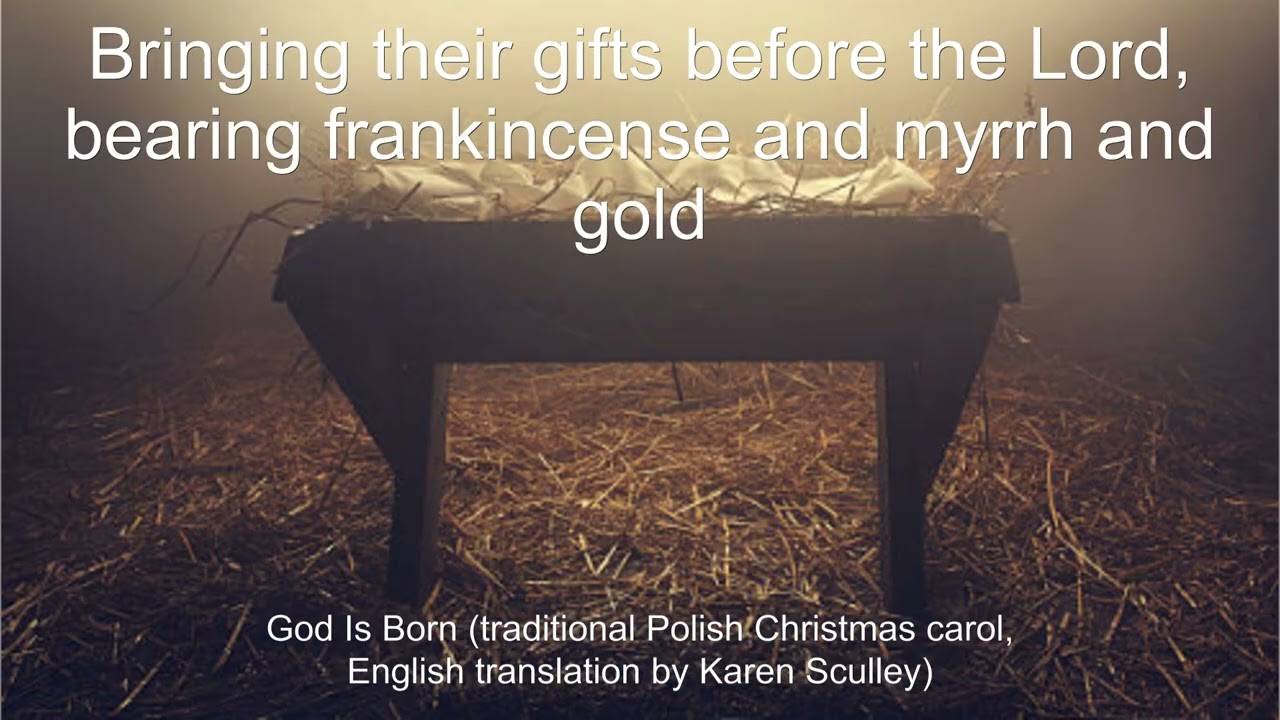
God Is Born (traditional Polish Christmas carol, English translation by Karen Sculley)
1. God is born and the powers tremble, the Lord of heaven now disclosed.
Fire is frozen, the radiance dims. What a feeble nature God has taken.
So despised, yet clothed in praises. Mortal, yet the King of ages.
Now, for all, the Word made flesh has come to earth to dwell among us.
2. What can heav’n offer us on earth? God has left his own bliss far behind.
God among his beloved people, to share in hardship and in toil.
How he suffered much, he suffered. All the fault belongs to us, yet
Now, for all, the Word made flesh has come to earth to dwell among us.
3. God is born in a wretched stable, a lowly manger for his cradle.
And with what is he now surrounded? Just cattle, shepherds, and some hay.
To the poor, it has been granted: you greet him before the wealthy.
Now, for all, the Word made flesh has come to earth to dwell among us.
4. Look and see how some kings now enter and crowd around among the simple,
Bringing their gifts before the Lord, bearing frankincense and myrrh and gold
God mixed poor and rich together in these humble offerings, for
Now, for all, the Word made flesh has come to earth to dwell among us.
5. Raise Your hand, divine child of God! Give our cherished homeland your great blessing.
In wise counsel and in well-being, sustain its strength with your own power.
Bless our homes, and bless our fortunes, ev’ry city, ev’ry town, for
Now, for all, the Word made flesh has come to earth to dwell among us.
So despised, yet clothed in praises. Mortal, yet the King of ages.
Now, for all, the Word made flesh has come to earth to dwell among us.