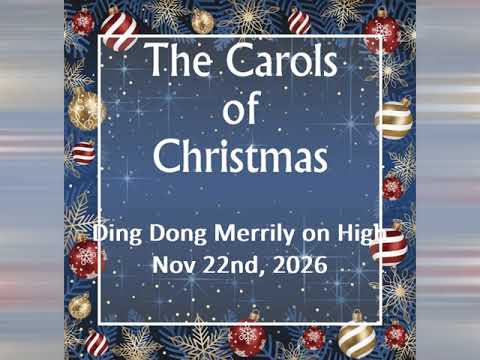
Ding Dong Merrily on High (Carols of Christmas 2026)
As both Mariana and JR have already mentioned in this year’s sermon series, The Carols of Christmas, the beginning of the Christmas story is a silent night, a night of peace. It’s when we wait in breathless expectation for Messiah to come. It’s the part of the story where we remember that, incredibly, the Creator of the universe was born in our broken world as a humble human baby to an ordinary family without wealth or influence in a community living under foreign domination. Today’s Christmas carol, “Ding Dong Merrily on High,” focuses on what happens immediately after the Messiah, the Christ, Jesus, is born. I think that both the music and the words encapsulate the absolute explosion of joy that erupted and overflowed when heaven came to earth!
The melody originated as a French dance tune, first mentioned in a 1588 dance book, Orchésographie, the best known work of Thoinot Arbeau, a French cleric, mathematician, and astronomer. Interestingly, this dance book, which provided innovative instructions for dance steps lined up with musical notes, along with woodcuts and tabulations, was partly written as a rebuttal of Calvinist treatises published at the time which argued that dance was an immoral and vain pastime. The lively tune we hear in “Ding Dong Merrily on High” is “Branle de l’Official.” Branle was a group dance typically performed in a circle. The name of the dance comes from a French verb meaning to shake, sway, or wobble. Dancers walked, glided, or skipped sideways to the left, then made the same number of smaller steps to the right, which meant that the circle gradually moved to the left.
Arbeau also published an astronomy and calendar manual, serving as a practical guide to understanding the recently introduced Gregorian calendar, “by which all people can easily learn and know the course of the Sun and of the Moon and similarly, the festivals with fixed and moveable dates which one celebrates in Church.” I can only imagine Arbeau’s delight in writing about the movements of both heavenly bodies and human ones!
Over 300 years later, the lyrics were penned by George Ratcliffe Woodward, an English Anglican priest best known as the prolific writer of both the words and music of many beautiful hymns and carols. A gifted translator, Woodward sought to reproduce the meter, rhyme scheme, and contents of the original songs, something I personally appreciate! He especially enjoyed employing macaronic language, which comes from the Italian word, macaroni. In the 16th century, macaroni referred to a coarse, rustic peasant dish of dumplings made from mixed ingredients. Scholars applied the term to poetry and songs that “tossed together” formal church Latin with common, everyday speech. Woodward incorporated into his songs many phrases from Greek, Latin, and German. An avid beekeeper and bellringer, he also formed the St. Barnabas Choral Society. “Ding Dong Merrily on High” was published by Woodward and his collaborator Charles Wood in 1924 in The Cambridge Carol-Book.
“Ding Dong Merrily on High” invokes contagious joy because of its seemingly never-ending line, “Glo–o-o-o-o-o-ooo-o-o-o-o-o-ooo-o-o-o-o-o-ooo-o-o-o-o-o-ooo-o-o-o-o-o-ooo-ri-a, Hosannah in excelsis!” When we sing that, we can almost hear the joyful singing of angels announcing the birth of Jesus. I was telling one of my daughters-in-love this week about this song, explaining the melisma in the word “Gloria.” Of course, y’all will remember the definition of melisma I gave you in my sermon on Angels We Have Heard on High in December 2024: Melisma is an Ancient Greek word meaning “song,” and is the singing of a single syllable of text while moving between several different notes in succession. In today’s Christmas carol, our melisma has 33 notes for the single word “Gloria.”
I would like to try a little vocal experiment today. Stand up with me, if you are willing to participate! First, please call out your answer to this question: How long do you think you can hold your breath? Our “gloria” melisma should take only 8-12 seconds. We are going to try to sing it in one breath! If you run out of breath, please sit down. Here’s our starting note – la! I’ll count to four and then we’ll see how we do.
Maybe that’s why we usually hear this sung by choirs, because then everyone can take breaths at different times! In any case, this refrain, “Gloria in excelsis Deo” sounds almost like a peal of bells or an outpouring of uncontainable joy. Isn’t it interesting that, unlike many other Christmas carols, this song doesn’t say anything about Jesus, the manger, Mary’s experience, the shepherds’ visit, or the wise men? Instead, it concentrates almost entirely on what the coming of Jesus causes heaven and earth to do. That makes it unusual among Christmas carols. The birth of Christ is such glorious news that heaven cannot remain silent, and neither should earth.
What does “ding dong merrily on high” even mean? Ding dong refers to bells ringing. Between the 5th and 11th centuries, it became increasingly commonplace for church buildings to contain bell towers. We’ve all seen these in books or movies, but we may not have experienced them in real life. While there are over 5000 churches in England with rings of five or more bells, there are fewer than 50 in the US. Church bells have traditionally been rung for several main reasons, usually as a call to worship, a call to prayer, or a call to a special celebration. The carol’s title and first line use church bells as a symbol of the universal celebration going on in heaven and on earth on the night that Jesus was born. Luke 2:14 tells us that a multitude of angels praised God saying, “Glory to God in the highest heaven …” Although the more famous Latin Vulgate translation of this is “Gloria in altissimis Deo,” the wording “Gloria in excelsis Deo” comes from an even earlier Latin translation of Luke traditionally attributed to Bishop and Doctor of the Church, Hilary of Poitiers. In any case, the New Testament includes thirteen references to the word translated “excelsis” in this carol, each time declaring God’s unrivaled majesty and locating the realm of His glory “in the highest.”
Woodward imagines the celebration of Christ’s birth as so wonderful that all creation participates. The angels are not merely announcing information. They are celebrating, praising God for the birth of Jesus. Everyone is invited to join this universal celebration, as heaven and earth and united in joyful worship!
I want to point out a couple of lyrical treasures tucked away that we might otherwise miss.
Firstly, can we appreciate the gorgeous and playful internal rhymes throughout this carol?
- Ding dong merrily on high … ding dong verily the sky
- In heav’n … is riv’n (split apart)
- the bells are ringing … with angel singing
- E’en so here below, below … and io, io, io
- bells be swungen (swing) … people sungen (sing)
- dutifully prime … beautifully rhyme
- ye ringers … ye singers
Secondly, the phrase “io, io, io” is a medieval abbreviation for iubilo, the Latin verb meaning “I rejoice” or “I shout for joy.” Woodward used this traditional expression of jubilation to mirror the ringing of the bells and the singing of the people.
Thirdly, it’s worth noting that the lyricist includes the canonical hours, fixed daily times of prayer, practiced in many liturgical churches. In the historic Western monastic tradition, the day was divided into eight periods of prayer, and four of these are referred to in this Christmas carol – evetime (called evensong in the Anglican tradition, combining Vespers and Compline, from sunset to the end of the day), matin (or Matins, during the night), and prime (the first hour of daylight, around 6am).
The use of these three in particular remind me of a beloved Scripture, Lamentations 3:22-23 – “The steadfast love of the Lord never ceases, his mercies never come to an end; they are new every morning; great is your faithfulness.” Let’s ponder this today as the firm promise from God that it is and an assurance that joy can exist alongside of grief. Let me explain that. In the Hebrew understanding, a new day begins in darkness, right after sunset. God’s mercies continue through the night, even when they cannot be clearly seen. Even though we might not feel God’s compassion in the dark places of our human experience, God’s mercies are already present through the night. Even when our circumstances remain unchanged, God’s mercies are new each morning, when we can literally see fresh evidence of God’s unfailing faithfulness. The night may be long. The new day may begin in darkness. But the morning reminds us that God’s mercy has endured through it all.
We do not celebrate because we’ve reached the end of the story – we are not there yet! Certainly, one day God will complete the restoration of all things. Today we live in the “already, but not yet” tension between the Kingdom of God having already arrived through Jesus Christ and its final fulfillment still awaiting his return. The “already” refers to the reality that Jesus has come. God’s reign has broken into human history. Sin and death have been decisively confronted. Jesus has inaugurated the Kingdom of God on the earth here and now. The “not yet” refers to the reality that evil, suffering, and death remain. However, when Christ returns, the Kingdom of God will be fully consummated, the dead will be raised, and God will make all things new.
We live in between the already and the not yet, in what we call the present age of the Church. What has happened in God’s story so far?
- Christ has defeated sin and death
- Believers have received eternal life
- The Holy Spirit has been given
- God’s Kingdom is present
- Believers are being transformed
- Reconciliation with God is available
- Followers of Christ experience God’s peace and joy
Meanwhile, we are waiting (waiting!) the not yet when Christ returns:
- Death will be abolished
- We will be resurrected and transformed bodily
- We will experience God’s presence in unhindered fellowship
- God’s reign will be universally acknowledged
- We will be completely free from sin and corruption
- Creation will be completely restored
- Suffering and sorrow will come to an end
Revelation 5:13 describes the celebration to come – “Then I heard every creature in heaven and on earth and under the earth and in the sea, and all that is in them, singing, ‘To the one seated on the throne and to the Lamb be blessing and honor and glory and might forever and ever!’”
But we have not reached the consummation of the Kingdom of God yet. We do not celebrate because everything is wonderful here and now. We celebrate because even when things go wrong here and now, God remains faithful, compassionate, merciful, trustworthy, and true! Our lives may be falling apart, our bodies may fail, loved ones may decline or die, relationships may falter, resources may be thin, insecurities may rise, disappointments may accumulate, injustices may abound, emotional distresses may cripple us, destructive choices may harm, confusion and fear may dominate, doubts may overwhelm, the world may seem to be falling apart. And yet, God’s mercies are new every morning! Great is your faithfulness, oh God!
One of the most appealing aspects of “Ding Dong! Merrily on High” is that it doesn’t focus primarily on the details of what happened when Jesus was born. Instead, it focuses on the response to the Incarnation. Jesus’ birth is not just something we check off our calendars. Heaven has come to earth – let’s celebrate! And what a celebration of joy! Joy cannot be hidden like a feeling.
Joy is expressed outwardly through music, movement, and communal celebration.
This is why we do what we do here at Liberty Vineyard Church! For 2000+ years, whenever Jesus’ followers have gotten together, we have always cultivated joy through singing, gratitude, and building up one another! The word translated “psalm” refers to any of the 150 Psalms in that book of the Bible. The word translated “hymn” in the New Testament comes from a word meaning “to celebrate” and is a song praising the triune God, manifested in the flesh in Jesus Christ, the God-man, sung about God – who God is, what God has done, and what God will do. The words translated “song” (as in “spiritual song” or “new song”) refer to spontaneous, unrehearsed melodies of praise sung to God from a Spirit-filled heart.
Colossians 3:16 – “…with gratitude in your hearts sing psalms, hymns, and spiritual songs to God.”
Ephesians 5:18b-20 – “be filled with the Spirit, as you sing psalms and hymns and spiritual songs among yourselves, singing and making melody to the Lord in your hearts, giving thanks to God the Father at all times and for everything in the name of our Lord Jesus Christ.”
Scripture describes joy in all kinds of ways!
- Joy is a gift from God: Psalm 16:11 – “… In your presence there is fullness of joy …”
- Joy is a response to salvation: 1 Peter 1:8-9 – “Although you have not seen him, you love him; and even though you do not see him now, you believe in him and rejoice with an indescribable and glorious joy, for you are receiving the outcome of your faith, the salvation of your souls.”
- Joy is a source of strength: John 15:11 – “I [Jesus] have said these things to you so that my joy may be in you, and that your joy may be complete.”
- Joy is a fruit of the Holy Spirit: Romans 14:17 – “For the kingdom of God is not food and drink but righteousness and peace and joy in the Holy Spirit.”
- Joy can coexist with suffering: 2 Corinthians 6:10 – “sorrowful, yet always rejoicing”
- Joy is audible: Psalm 100:1-2 – “Make a joyful noise to the Lord, all the earth. Worship the Lord with gladness; come into his presence with singing.”
- Joy is relational: Romans 12:15 – “Rejoice with those who rejoice, weep with those who weep.” Joy is connected with God’s creation: Isaiah 55:12 – “you shall go out in joy, and be led back in peace; the mountains and the hills before you shall burst into song, and all the trees of the field shall clap their hands.”
- Joy is eternal: Jude 1:24-25 – “Now to him who is able to keep you from falling, and to make you stand without blemish in the presence of his glory with rejoicing, to the only God our Savior, through Jesus Christ our Lord, be glory, majesty, power, and authority, before all time and now and forever.”
I invited each of you this week to identify regular practices that have cultivated joy in your life. I added them to the list of things explicitly stated in the Scriptures we read and share them all here to offer us all some possible pathways. There are any number of ways to cultivate joy! Here is our compilation … I encourage you to jot down three that you would like to start or deepen in this season of your life:
- Abiding in Christ
- Adding beauty
- Admiring beauty
- Anticipating and sharing special times with family and friends
- Baby steps
- Being myself
- Being outside
- Being present
- Bible reading
- Birds
- Butterflies
- Celebrating with others
- Chatting with friends on the phone
- Christian fellowship
- Christmas
- Cleaning up trash in our community
- Coffee and reflection in the morning
- Creative projects
- Dancing, clapping, raising hands
- Directing attention to God’s goodness
- Expressing thanksgiving
- Flowers
- Giving of time and treasure to others
- Giving with love
- Hospital visits
- Hospitality in my home
- Hugging
- Interdependent relationships
- Interacting with friends
- Learning new or interesting things
- Listing the things that I am grateful for
- Music
- Noticing the little things
- Offering one of my bright smiles
- Overnight guests
- Pets
- Planning surprises
- Playing games with others
- Praying
- Preparing sermons, teachings, and reflections
- Rainbows
- Reading great books, alone and with others
- Rejoicing in the Lord!
- Remembering God’s goodness
- Sending encouraging messages to friends
- Serving others
- Sharing a meal
- Shouting praise
- Singing and making music with others
- Sitting with God in silence
- Smiling or laughing together
- Solving puzzles
- Spending time with the elderly and their caregivers
- Studying
- Sunflowers
- Sunshine
- Thankfulness journal
- Time with children
- Walking in nature
- Watching game shows on TV with family members and guessing answers
- Worshiping God in song
- Writing a poem a day about something beautiful
Joy is simultaneously something we receive, something we experience, something we express, and something we encourage.
I pray that this Christmas season, your joy and my joy would be evident as light dispelling the darkness, as a rainbow brightening the stormy sky, as a flower emerging from the ashes. And now, let us celebrate, let us rejoice, let us sing!

1. Ding dong, merrily on high!
In heav’n the bells are ringing;
ding dong, verily the sky
is riv’n with angel singing.
Gloria, hosannah in excelsis!
Gloria, hosannah in excelsis!
2. E’en so here below, below,
let steeple bells be swungen,
And io, io, io,
by priest and people sungen.
Gloria, hosannah in excelsis!
Gloria, hosannah in excelsis!
3. Pray ye dutifully prime
your matin chime, ye ringers;
may ye beautifully rhyme
your evetime song, ye singers.
Gloria, hosannah in excelsis!
Gloria, hosannah in excelsis!