James 1 (James: Consistency of Belief and Behavior)


James 1 (James: Consistency of Belief and Behavior) – Sep 20th, 2026
Introduction
Welcome to our new five-week sermon series, “James: Consistency of Belief and Behavior.” Traditionally, this epistle is attributed to James the brother or cousin of Jesus, also known as James the Just. The book of James does not reflect on the identity, nature, or work of Jesus Christ; it develops no theological beliefs; it does not address any particular church issue. From start to finish, James promotes the wholeness and completeness that comes to followers of Jesus Christ when we walk straight in line with our convictions, resulting in transformation of our whole person, in our mind, our heart, our speech, our actions, our lives. New Testament Professor Ruth Anne Reese notes that “the inclusion of the book of James in the canon is a reminder that God reaches out to humanity through different voices … a 66-book choir singing God’s song, not with one single note but in a complex interweaving of voices stretching across the centuries.”
I have chosen nine works of art that we are going to visit today as we stroll around a special James 1 exhibit in an art gallery together, pausing to reflect on the gifts that each one offers us. You can see the artworks on one of your handouts and on the TV screen. Your other handout has nine corresponding blank spaces in which you are welcome to jot a brief reflection. At the conclusion of this sermon, you will have an opportunity to share one of your reflections with the rest of us. Lord, we ask you to help us to hear your voice and notice what you want us to notice, that we would become more conformed to you in our mind, our heart, our speech, our actions, and our lives. Come, Holy Spirit!
Greetings. All joy!
James 1:1 – “James, a servant of God and of the Lord Jesus Christ, To the twelve tribes in the Dispersion: Greetings.”
#/media/File:Santiago_el_Mayor_(El_Greco).jpg)
Notice artwork #1, El Greco’s 1610 painting, “Saint James the Great.” James begins his greeting by identifying himself with the least honorable position in society. 10th century biblical commentator Oecumenius notes that “more than any worldly dignity, the Lord’s apostles gloried in the fact that they were slaves of Christ. That is how they wanted to be known in their preaching, in their writing, and in their teaching.”
I’m happy to tell you that my friend James tucks a lot of rhetorical treasures into his letter. He even makes a wordplay in the first two verses, such that the last word of James 1:1 and the first two words of James 1:2 read chairein. Pasan charan (“Greetings. All joy!”) Isn’t that beautiful? I invite you now to jot down a brief reflection on line 1.
Facing trials with joy leads to wholeness
James 1:2-4 – “My brothers and sisters, whenever you face trials of any kind, consider it nothing but joy, because you know that the testing of your faith produces endurance; and let endurance have its full effect, so that you may be mature and complete, lacking in nothing.”
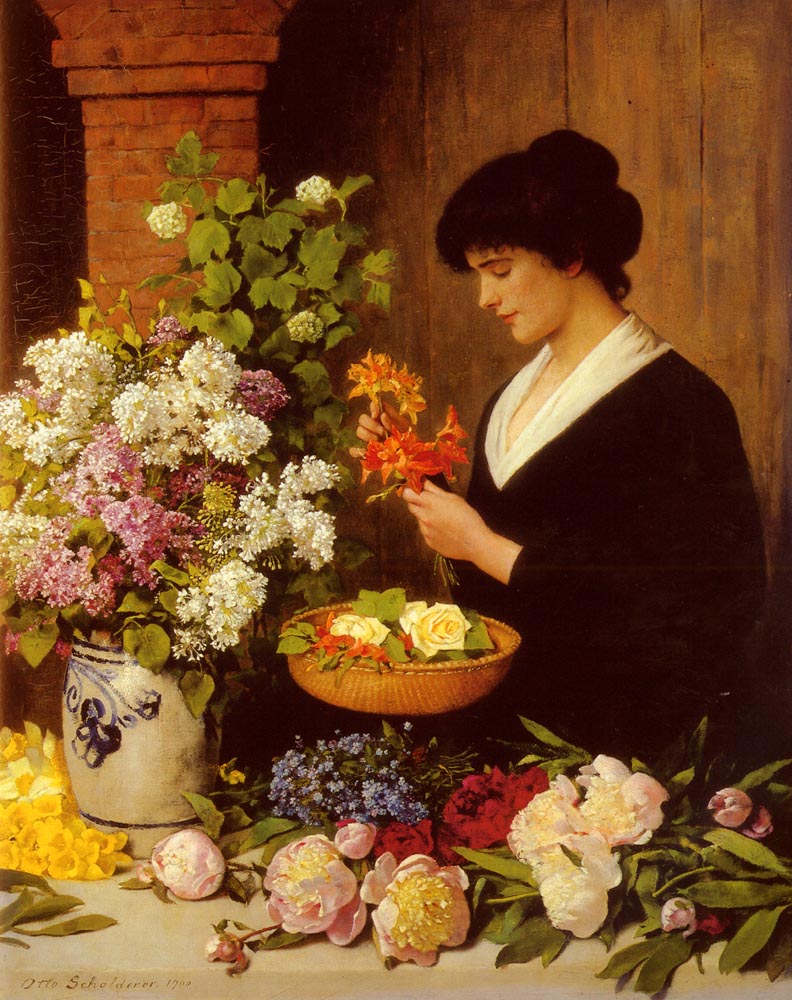
Notice artwork #2, Otto Scholderer’s 1900 painting, “The Flower Arrangement.” Think about the way we normally react to a trial in our lives: anxiety, stress, seeking comfort, numbing out, going around it, trying to control it. James offers us a radical and life-giving alternative. How would our lives be different if we followed James’s instruction to consider not the trials themselves but the facing of trials of any kind as nothing but joy? Oscar Wilde wrote that “A flower blossoms for its own joy.” Flower arrangements exponentially increase joy, but they don’t appear spontaneously. What if, each time we faced a trial of any kind, we were to select a gorgeous stem (whether figuratively or literally), arrange these with great care into a beautiful bouquet, and offer our flower arrangement to God as an intentional act of worship?
In the mystery of the kingdom of God, the trials and temptations we face become the very place where our faith is refined to produce endurance which enables us to hold on with grit and courage. And this is how we experience greater wholeness, which James describes as “mature and complete, lacking nothing.” I invite you now to jot down a brief reflection on line 2.
God’s good gifts of wisdom and the Holy Spirit
James 1:5-8 – “If any of you is lacking in wisdom, ask God, who gives to all generously and ungrudgingly, and it will be given you. But ask in faith, never doubting, for the one who doubts is like a wave of the sea, driven and tossed by the wind; for the doubter, being double-minded and unstable in every way, must not expect to receive anything from the Lord.”
#/media/File:Der_ungl%C3%A4ubige_Thomas_-_Michelangelo_Merisi,_named_Caravaggio.jpg)
Notice artwork #3, Caravaggio’s 1602 painting, “The Incredulity of Saint Thomas.” I chose to highlight Thomas because he is so relatable. Poor guy, he ended up with the nickname Doubting Thomas and his story has been told everywhere for 2000 years. But although Thomas doubted initially, Jesus was very willing to show him his side and help him to move forward, going on to become the first apostle to bring Christianity to India.
2nd century former slave Hermas encourages us to count on the Lord’s mercy: “Put away doubting and do not hesitate to ask of the Lord … turn to the Lord with all your heart and ask of him without doubting, and you will know the multitude of his tender mercies, that he will never leave you but fulfill the request of your soul.”
It would be easy to focus so much on avoiding being double-minded that we miss this good news: God willingly, generously, and ungrudgingly gives wisdom, the Holy Spirit, to all, if we ask in faith. James’s focus here is not on our doubting but on God’s character. We can be assured that when we ask in faith, we can rest assured that God will fulfill our request. I invite you now to jot down a brief reflection on line 3.
Unexpected reversal
James 1:9-11 – “Let the believer who is lowly boast in being raised up, and the rich in being brought low, because the rich will disappear like a flower in the field. For the sun rises with its scorching heat and withers the field; its flower falls, and its beauty perishes. It is the same way with the rich; in the midst of a busy life, they will wither away.”
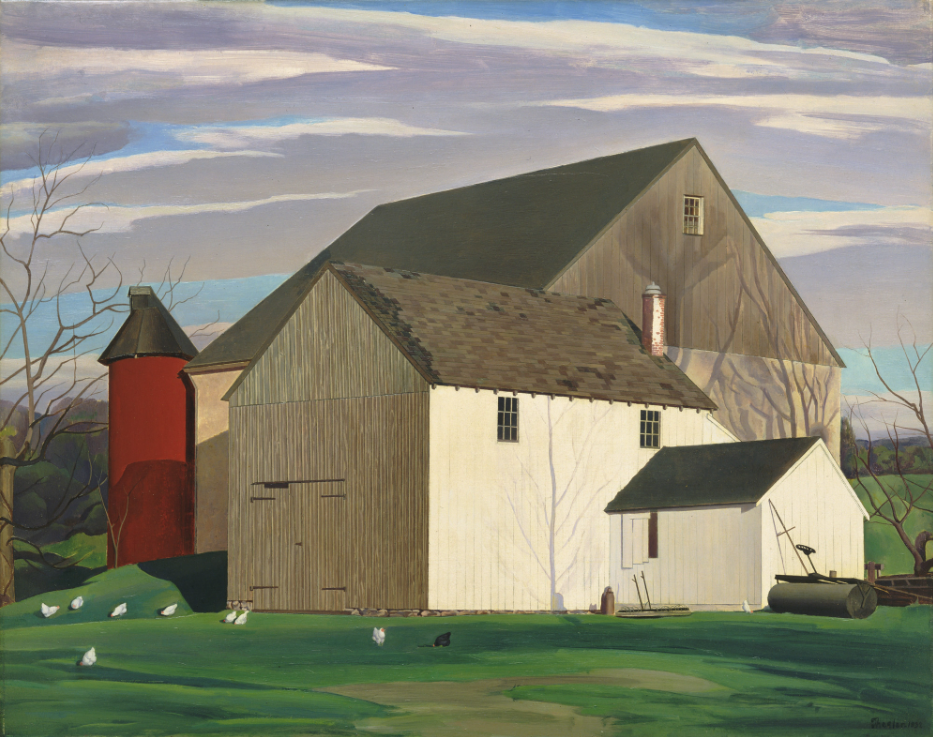
Notice artwork #4, Charles Sheeler’s 1940 painting, “Bucks County Barn.” The magnitude of these barns paired with James’s reference to “the rich” remind me of Jesus’ Parable of the Rich Fool. Luke 12:15 records Jesus’ warning to his hearers, “Be on your guard against all kinds of greed; for one’s life does not consist in the abundance of possessions.” Jesus then goes on to tell the parable. A rich man’s land produced abundantly, so much so that he said, “I will pull down my barns and build larger ones, and there I will store all my grain and my goods. And I will say to my soul, ‘Soul, you have ample goods laid up for many years; relax, eat, drink, be merry.’” But God said to him, “You fool! This very night your life is being demanded of you.”
James focuses relentlessly on that which is fleeting and short-lived, like the flowers of the field. Similarly, neither the rich nor the poor will escape death. All persons, both rich and poor, are ultimately dependent upon God. Even though the poor are powerless now, God will raise them up in the end. Even though the rich may seem powerful now, unless they humble themselves now, God will bring them low in the end. This is an unexpected reversal of status and one that invites us to soberly reflect on our own lives. I invite you now to jot down a brief reflection on line 4.
Trials, temptation, and sin
James 1:12-15 – “Blessed is anyone who endures temptation. Such a one has stood the test and will receive the crown of life that the Lord has promised to those who love him. No one, when tempted, should say, “I am being tempted by God”; for God cannot be tempted by evil and he himself tempts no one. But one is tempted by one’s own desire, being lured and enticed by it; then, when that desire has conceived, it gives birth to sin, and that sin, when it is fully grown, gives birth to death.”

Notice artwork #5, an ornately illustrated, highly symbolic calligraphic artwork of the Lord’s Prayer designed by W. A. Welsher in 1873. I chose this because of the part of the Lord’s prayer in which Jesus teaches us to pray, “do not bring us to the time of trial, but rescue us from the evil one” (Matthew 6:13). The same Greek word can be translated as either “trial” or “temptation” and James includes six variations of it in this section. James is very clear that God tempts no one. Bede, a theologian of the Early Middle Ages, wrote that “in three ways all manner of sin is fulfilled … suggestion, delight, consent.” It’s not the suggestion or even the delight that is sinful. It is when we consent that we are, as James puts it, lured and enticed by our own desire, and that’s what leads to sin, which, unchecked, eventually leads to the path of death.
Sidebar about James’s choice of words here: In the ancient world, births happened in small homes in close quarters without sound proofing. Pregnancy, labor, and childbirth were commonly understood by all because they frequently heard and sometimes saw their female family and friends experiencing these things. James makes an analogy based on this common understanding in order to explain temptation. Unfortunately, many English translations obscure some of the original meaning by translating two different verbs with “gives birth to.” As a seminarian and one who has given birth multiple times, I am delighted to hopefully shed some light on this today! James uses three verbs in his explanation: sullambanó, conception (the point at which something new begins to grow), tiktó, travail (today, we call that labor and transition, which is the most difficult and painful final stage), and finally, apokueó, delivery, when there is definitely no turning back, and the point at which a pregnant woman gives birth.
Temptations come, for sure, but no one can make us sin, not God, not the world, not the devil. A suggestion may come from any source other than God (including ourselves), and our mind may be tempted to engage in the mental delight of a suggestion. At either of these stages, we can turn back before consenting to act upon the suggestion or the delight. But if we do sin, it’s because we have given in to a suggestion, and we have delighted in that idea, and we have consented to our own desire. And if we keep on consenting, our own desire ends up leading us into sin, which may seem delightful initially but inevitably will become increasingly characterized by travail, difficulty, and pain. If we keep going in that direction, our sin will eventually give birth to death.
2 Peter 3:9 says that “The Lord is not slow about his promise, as some think of slowness, but is patient with you, not wanting any to perish, but all to come to repentance.” God does not condemn anyone to death. If we find ourselves on the path of death, it’s because we have willingly given up the way of life; we have willingly chosen the path of death. Condemnation is a consequence of our choice to cling to sin. To get back on the right path, the way of life, we need to repent, turn around, and go the other way. We need to humbly acknowledge our sin and submit to the Lordship of Jesus. And the Lord will forgive, restore, heal, and save us because that is who God is! I invite you now to jot down a brief reflection on line 5.
God’s good gift of life
James 1:16-18 – “Do not be deceived, my beloved [sisters and brothers]. Every generous act of giving, with every perfect gift, is from above, coming down from the Father of lights, with whom there is no variation or shadow due to change. In fulfillment of his own purpose he gave us birth by the word of truth, so that we would become a kind of first fruits of his creatures.”

Notice artwork #6, Yayoi Kusama’s 2013 immersion installation artwork, “Infinity Mirrored Room—The Souls of Millions of Light Years Away.” This artwork speaks to me simultaneously of the radical generosity of our great God, the Father of lights, and of God’s passionate pursuit for each and every person, each one created in love to bear God’s image and likeness as God’s beloved children. Early church theologian, Origen, wrote in the early 3rd century, “The soul gradually … goes through many stages during which it is progressively enlightened by the light of Wisdom until it arrives at the Father of lights himself.” James assures us that God gives his gifts of wisdom, the Holy Spirit, and life with no strings attached! God gives these freely to all persons, even though none of us are able to repay.
James tells us that God brought us forth by the word of truth, the logos, because God willed it. God freely chose to create the entire universe and us by speaking words with his voice (see Genesis 1). Then about 2000 years ago, God freely chose to send the logos, the Word who was with God, the Word who was God, Jesus Christ (John 1:1). And now because of his life, ministry, death, and resurrection, James speaks of our new life in Christ as starting with God’s will, which leads to the word of truth, which leads to the birth of the community of faith which we call the church, a sign of God’s work and presence in the world. And in all of this, God’s own purposes are fulfilled. God chose us and wants us! God chose you and wants you! I invite you now to jot down a brief reflection on line 6.
Welcoming the voice of God
James 1:19-21 – “You must understand this, my beloved [brothers and sisters]: let everyone be quick to listen, slow to speak, slow to anger; for your anger does not produce God’s righteousness. Therefore rid yourselves of all sordidness and rank growth of wickedness, and welcome with meekness the implanted word that has the power to save your souls.”
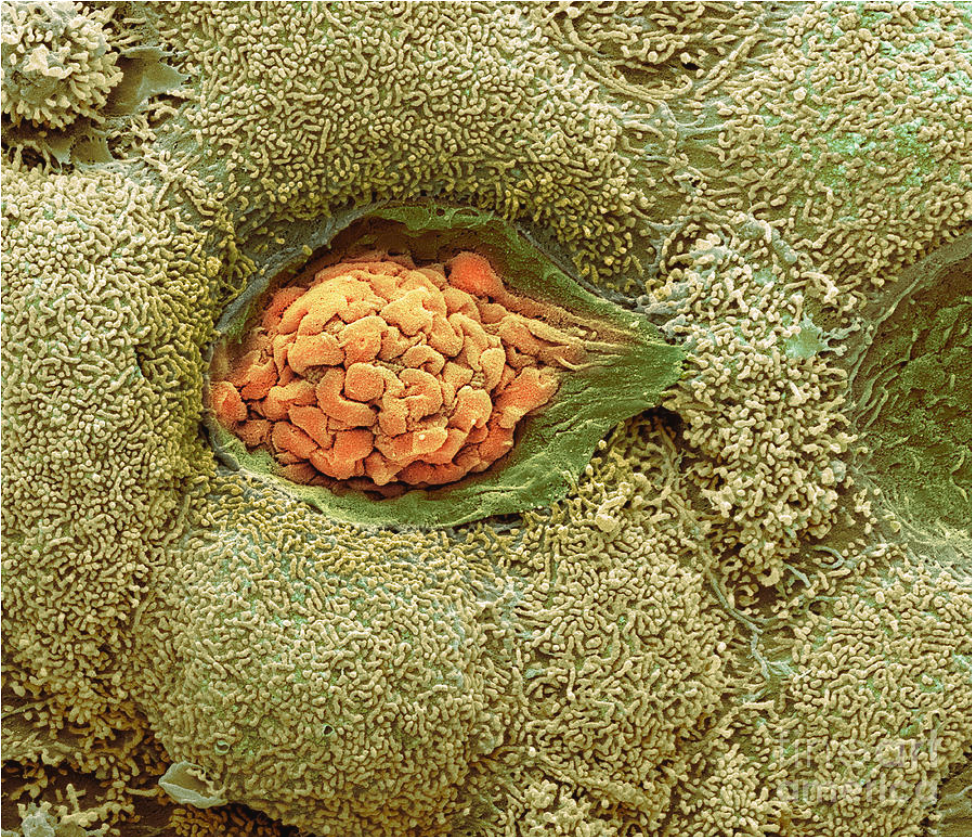
Notice artwork #7, Steve Gschmeissner’s 2022 colored scanning electron micrograph of ear wax being secreted by a gland in the ear canal (with 3000 times magnification). I have a weird funky ear canal in my right ear, which means that I end up with an accumulation of ear wax, a beneficial substance that actually cleans and protects our ear canals. Every year or two, when I start to notice that sounds are becoming muffled, I visit my doctor, and after some oil and the injection of a waterfall into my ear canal, hallelujah, my hearing is restored!
I didn’t realize until this week that the sordidness that James tells us to rid ourselves of comes from the Greek word for “ear wax!” James is telling us to get rid of what is preventing us from hearing the logos, not just the written word but the living word, the voice of God-in-the-flesh, Jesus Christ. James adds an adjective – the implanted word, the Holy Spirit sent by Jesus to indwell us, the church. Consider whatever might prevent us from hearing the voice of the Holy Spirit, perhaps noise, distractions, busyness, procrastination, stress, evil practices, injustice, apathy, angry words … the possibilities are endless. Finally, James adds that we are to welcome the voice of God with meekness, a kind of gentle strength with humility, because it has the power to save our psyche, which is not just our souls, your whole self, your being, you. I invite you now to jot down a brief reflection on line 7.
Being doers of the word
James 1:22-25 – “But be doers of the word, and not merely hearers who deceive themselves. For if any are hearers of the word and not doers, they are like those who look at themselves in a mirror; for they look at themselves and, on going away, immediately forget what they were like. But those who look into the perfect law, the law of liberty, and persevere, being not hearers who forget but doers who act—they will be blessed in their doing.”

Notice artwork #8, Van Gogh’s 1890 painting, “The Good Samaritan.” Jesus’ beloved parable has given the world an exemplar of what it looks like to love God and neighbor. New Testament scholar Ben Witherington III comments that James’s instruction to “be doers of the word” is “a salutary lesson against those who pride themselves on their orthodoxy, but who have so spiritualized and allegorized the gospel’s demands that they do not take seriously the cost of discipleship and the demand for deeds of compassion and righteousness.”
With regard to James’s law of liberty, Reese challenges us to not focus on ourselves and whether or not we are free: “Freedom is found not through the removal of responsibility but rather through being embedded in good communal relationships with God and with others … The person who looks into the law of freedom is ultimately freed from evil and instead bound with love.”
For James, our salvation is evidenced in the life of faithful action oriented around loving God and loving neighbors. And as we do so, both community and individuals will experience a greater sense of shalom – flourishing, wholeness, and delight – and we will be blessed in our doing. I invite you now to jot down a brief reflection on line 8.
Pure and undefiled religion
James 1:26-27 – “If any think they are religious, and do not bridle their tongues but deceive their hearts, their religion is worthless. Religion that is pure and undefiled before God, the Father, is this: to care for orphans and widows in their distress, and to keep oneself unstained by the world.”

Notice artwork #9, Tony Cuboliquido’s 1974 3D anamorphic street painting, “Mayday, Mayday, the Raft of Human Rights.” 2nd century Hermas offers us a radical invitation in order to obey James’s instruction here: “Instead of fields, buy souls that are in trouble, according to your ability. Look after widows and orphans. Do not neglect them. Spend your riches on these kinds of fields and houses.”
We may have heard Christians say that keeping ourselves from being stained, corrupted, or polluted by the world has to do with avoiding outward worldly things like entertainment, media, immodesty, or partaking of certain substances. But as Reese observes, “these things in themselves are not the source of purity. Instead, striving for purity in relationship with God will involve not only outward works, such as rightly oriented speech and care for the poor and vulnerable, but also inward characteristics, such as wisdom, peace, gentleness, genuineness, and nonjudgmental attitudes towards others.” I invite you now to jot down a brief reflection on line 9.
I hope you have not only enjoyed but experienced Holy Spirit transformation through this stroll around an art gallery with James in chapter 1 of his epistle. I want to invite you now to share one of your brief reflections with the rest of us, as we gather the gifts God has given us today.