James 3 (James: Consistency of Belief and Behavior)

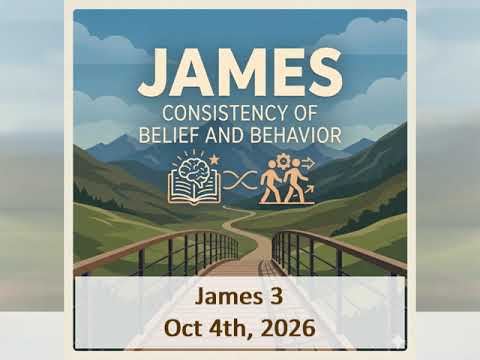
James 3 (James: Consistency of Belief and Behavior) – Oct 4th, 2026
In Spring 2025 during our sermon series on Jesus: the Healer, the Lord birthed something which has since been developed and refined to become a precious part of our DNA here at Liberty Vineyard Church. Here’s what I’ve written about this on our church website, www.LibertyVineyardChurch.com:
“Four times a year, our Sunday morning worship service is a highly participatory blend of Scriptures, songs, and saints focused on one theme, as we worship our triune God in the grace of the Lord Jesus Christ, the love of God, and the communion of the Holy Spirit in what we call Scriptures, Songs, and Saints (SSS)! Here are the ways in which SSS differs from our regular worship services:
- In place of our regular Scripture-based sermon in which we hear from one voice (someone present in the room, whether Pastor Karen, a member of our wonderful preaching team, or a guest teacher), during SSS, we instead hear from many voices, those of the saints (Christians who have gone before us and are not present with us in the room). These saints’ voices are made audible through those who are present in the room to read aloud a Scripture or a quote from one of these saints.
- Our regular worship services usually include five songs; during SSS, we sing many songs, with Scriptures and quotes from saints interspersed between songs.
- During our regular worship services, we remain in our seats to receive the Communion elements. During SSS, we move our bodies to the Communion table to receive bread (“The body of Christ given for you”) which we then dip into a common cup (“The blood of Christ shed for you”).
- When we do SSS, the entire worship service is focused on one theme (scroll down to see previous themes).
When we do Scriptures, Songs, and Saints, everybody gets to play! Scriptures, Songs, and Saints has become a precious part of our Liberty Vineyard DNA!” I am happy to announce that in three weeks’ time, on October 25th, Tamera will be leading our next Scriptures, Songs, and Saints worship service focusing on “Love.”
The very reason that we read Scriptures and quotes from saints is precisely because what they said contains great power and influence even hundreds or thousands of years after they said it. We would all do better to give more thought to the words we say and the words we write. Ever since God gave us the gift of life, we humans have been using speech, both spoken and written. It would be hard to miss the significance of Genesis 1:26, in which God said, “Let us make humankind in our image, according to our likeness,” given to us just a few verses after God created everything else that there is – the heavens, the earth, light, sky, plants, animals – everything – from nothing, through an intentional act of God’s will, and by speaking all things into existence. The author of Genesis relates simply and straightforwardly that “God said, “Let there be light”; and there was light” (Genesis 1:3), and so forth. God’s speech has unfathomable power and influence! Of course, we humans cannot create something from nothing, as God does. But God has given all humans the gift of power and influence in our speech. And, like all gifts which God has given to humankind, we are free to decide whether to use these gifts for good or for evil.
In this short series on the book of James: Consistency of Belief and Behavior, today we are looking at James chapter 3, in two short sections.
The first section is James 3:1-12 – “Not many of you should become teachers, my brothers and sisters, for you know that we who teach will be judged with greater strictness. For all of us make many mistakes. Anyone who makes no mistakes in speaking is perfect, able to keep the whole body in check with a bridle. If we put bits into the mouths of horses to make them obey us, we guide their whole bodies. Or look at ships: though they are so large that it takes strong winds to drive them, yet they are guided by a very small rudder wherever the will of the pilot directs. So also the tongue is a small member, yet it boasts of great exploits. How great a forest is set ablaze by a small fire! And the tongue is a fire. The tongue is placed among our members as a world of iniquity; it stains the whole body, sets on fire the cycle of nature, and is itself set on fire by hell. For every species of beast and bird, of reptile and sea creature, can be tamed and has been tamed by the human species, but no one can tame the tongue—a restless evil, full of deadly poison. With it we bless the Lord and Father, and with it we curse those who are made in the likeness of God. From the same mouth come blessing and cursing. My brothers and sisters, this ought not to be so. Does a spring pour forth from the same opening both fresh and brackish water? Can a fig tree, my brothers and sisters, yield olives, or a grapevine figs? No more can salt water yield fresh.”
Although this chapter begins with a warning to teachers, very early on, in James 3:2, James clarifies that it’s not only teachers who need to be careful about their speech, but “all of us.” James’s instruction to us all concerns the unseen, often unconsidered, power and influence of all speech.
As I’m obviously thinking a lot today about our upcoming visit to our grandchildren, I want to invite us to think for a moment about when babies come into the world. What’s the first thing that happens after a baby is born? Even before the child receives an APGAR score, assessing baby’s color, heart rate, reflexes, muscle tone, and breathing at 1 and 5 minutes after birth; even before baby is placed on mama’s or dada’s chest for skin-to-skin contact; even before baby’s umbilical cord is clamped; the first thing that happens after baby is born is baby’s first breath and cry – waaaah! In addition to this first cry serving to clear fluid from baby’s airways, baby’s first act of speech also announces, “Here I am!” That first act of speech prepares us to then continue speaking for the rest of our breathing days! In 2005 it was discovered that, although there are certainly variations based on gender and age, the average person speaks aloud about 15,900 words per day. However, recent large-scale studies show that this has dropped to 12,700 words per day, due to our increasing reliance on digital tools, texting, and automated services. Still, we continue to engage in speech a lot, whether spoken out loud or written down in some form. And something we all understand, even from a very early age, is that we have the potential to use our words in both helpful and harmful ways. New Testament scholar Ben Witherington III notices that James “shows the frustration of human existence – persons seem to be able to control and subdue every other sort of creature, except themselves, and especially the tongue.”
In James 3, James offers instruction that was radical in the ancient world. Teaching in the Greco-Roman world was dominated by “moralists,” classical philosophers or writers who focused on practical ethics, personal character, and how to live a good, virtuous life. These moralists believed it was possible to control speech. In sharp contrast, James states bluntly, “No one can tame the tongue” (James 3:8), acknowledges that “all of us make many mistakes” (James 3:2), and concludes that human perfection is impossible. Although the moralists sounded optimistic, they had it wrong. James recognizes straight up the tongue’s capacity for not just minor slip-ups describing it as “a restless evil,” using the Greek word kakos, which describes consequences that are bad, evil, wicked, harmful, inner malice, foul, rotten, of a bad nature, not such as things ought to be.
James calls the human tongue “a world of iniquity,” “a restless evil, full of deadly poison,” even a cosmic force that “sets on fire the cycle of nature.” James 3:5 includes some attention-getting alliteration, which of course is obscured in our English translations: the tongue is a mikron melos (small member) that boasts of megala (exceeding things, great exploits) … the tongue is a hēlikon pyr (small fire) that kindles a hēlikēn hylēn (great forest).
The moralists of the Greco-Roman world saw the control of one’s speech as primarily an ethical matter. In sharp contrast, James draws our attention to the relational significance of our speech. How we speak, along with how we act, is to be patterned after God’s speech and actions. We are created and redeemed for a love-based relationship with God and love-based relationships with one another. We are to use our speech for good, not to just tick off boxes in order to please God. Through our speech, we are to put love into practice, to announce the good news that the God who created the universe is the God who came to us in the person of Jesus Nazareth who initiated the bringing of heaven to earth, the one true God who is changing the way things are, radically and forever.
Think about how Jesus spoke – he didn’t stay quiet – not only did he do stuff; he spoke! I want to read a long quote from N. T. Wright who expresses this so beautifully: “Jesus … was constantly telling stories to explain, as only subtle and challenging short stories can, that the way God was becoming king was very different. And equally important, he was constantly doing things that showed what God’s new world was going to look like. People were healed – a sign of new creation reaching out to embrace actual human bodies and lives. People found forgiveness, as the power of new creation reached into their moral and spiritual lives with the warm assurance of God’s love. People who had seen themselves at the bottom of the pile, economically, socially, morally, and physically, suddenly found their lives turned upside down … The good news is that the one true God has now taken charge of the world, in and through Jesus and his death and resurrection … Life has come to life and is pouring out like a mighty river into the world, in the form of a new power, the power of love. The good news was, and is, that all this has happened in and through Jesus; that one day it will happen, completely and utterly, to all creation; and that we humans, every single one of us, whoever we are, can be caught up in that transformation here and now. This is the Christian gospel.”
This good news that Jesus spoke and showed is the same good news we get to speak and to show, in real speech and real actions. So, when we read James, let’s notice whether we are hearing James’s words as rule-bound moralists or as beloved family members. In other words, are we more concerned about getting our words “right” so that we don’t mess up? Or, are we hearing James’s words as beloved sons and daughters of the king of the universe who are beloved sisters and brothers to one another? May the main reason we care about our words be this: It is in our very speech and in our very actions that the astounding, all-encompassing, absolute, authentic love of God is made visible here on earth, as it is in heaven!
May we be very careful to whom we pledge our allegiance. James offers us only two choices and makes it clear that the choice we make ultimately shapes all human activity, including our speech. On the one hand, the wisdom from above leads us into friendship with God; on the other hand, the wisdom from below is seen in friendship with the world. James makes it clear that friendship with the world is completely incompatible with friendship with God. We must choose our allegiance carefully because our words have the potential to destroy both ourselves and others. Consider this description of how errors crept into the early church: “For being power-hungry and filled with the wisdom of the world, they preached with the force and zeal of orthodox teachers, gathering a crowd with no trouble at all and deceiving them, mixing human things with the divine, so that the hearers might be dazzled by the newness of what was being said.” You might think this was written in our generation, but these words of wisdom were written by someone known as Andreas in the seventh century.
New Testament professor Ruth Anne Reese offers practical guidance: “Speech can be used to encourage, to lift others up, to compliment, and ultimately to bless. Blessing takes place as we look into the eyes of another person often accompanied by gentle appropriate touch and speak their true identity: child of God, beloved, worthy, honored. But speech is also used to abuse others: hate speech that tears people down based on their religion, race, or sexuality. Many think they are justified in speaking of people who are not like themselves as if they deserve hatred and disrespect … There are literally ways in which humans can kill each other with their speech … the easiest people to harm with one’s tongue are those with whom we are the most familiar: family and friends. The very intimacy of our relationships gives us knowledge that we can use to deeply wound our closet relationships with words.”
The second section is James 3:13-18 – “Who is wise and understanding among you? Show by your good life that your works are done with gentleness born of wisdom. But if you have bitter envy and selfish ambition in your hearts, do not be boastful and false to the truth. Such wisdom does not come down from above, but is earthly, unspiritual, devilish. For where there is envy and selfish ambition, there will also be disorder and wickedness of every kind. But the wisdom from above is first pure, then peaceable, gentle, willing to yield, full of mercy and good fruits, without a trace of partiality or hypocrisy. And a harvest of righteousness is sown in peace for those who make peace.”
James goes into this last section by calling our attention to wisdom. He has already urged us to ask God if we are lacking in wisdom (James 1:5). In today’s passage, James’s focus is to call us away from trying to be friends with everyone, away from trying to live simultaneously by pleasing God and pleasing everyone else. The Greek words James chooses sound choppy and abrupt. What is missing here is any kind of harmony, alliteration, assonance, rhythm, or rhyme. He equates allegiance to the world with bitter envy, selfish ambition, boastfulness, lying, disorder, and wickedness of every kind. James conveys to us through his words and even in how his words sound that this antiwisdom creates chaos, disorder, and violence!
James offers us a breathtakingly simple call to repentance, to change our minds to be like the mind of Christ. New Testament scholar Luke Timothy Johnson reminds us that “God has placed all of human life within an open system, one drenched by gifts from God, one that bestows being and identity and worth not from what humans can seize and control but by simple reception in meekness of what God implants in us.” As we submit ourselves to God in humility, drawing near to God in faith, we are then able to see reality through the lens of the wisdom from above. Then we can rest in the assurance that whatever we lack, God “gives to all generously and ungrudgingly” (James 1:5).
James points us to the contrast between supposed wisdom that is demonic and wisdom that is from above. One sure way to tell the difference is that wisdom that is demonic carves up Christ’s body and puffs up the so-called wise person. In describing wisdom from above, James starts with the most important quality, hagnos. This has nothing to do with ritual purity; it refers to a kind of inner innocence that then leads to the other qualities of the wisdom from above. I was delighted to discover James’s use of alliteration and rhyming for rhetorical effect in the words that follow. As we talked about a good bit two weeks ago, we now know that the early church did not just read gospels and letters such as this: they were performed. Early listeners would have heard in quick succession four “e” words followed by three “a” words – ei-rē-ni-kē, e-pi-ei-kēs, eu-pei-thēs, e-lέ-ous, a-ga-thōn, a-di-ά-kri-tos, a-ny-pό-kri-tos. It is almost as though James wanted to gently hammer these things into the hearts and minds of his listeners, because each of these words describes the effects of godly wisdom on human beings. These are the fruits observable in ourselves and others when we speak and act in accordance with the wisdom from above – we will ourselves become more peaceable, gentle, reasonable, full of mercy, good, impartial, and sincere.
The Bible itself and many saints through the ages equate the wisdom from above with love. One of the two best definitions of love, well worth memorizing and adopting as a rule of life, is in 1 Corinthians 13:4-7 – “Love is patient; love is kind; love is not envious or boastful or arrogant or rude. It does not insist on its own way; it is not irritable or resentful; it does not rejoice in wrongdoing, but rejoices in the truth. It bears all things, believes all things, hopes all things, endures all things.” We think we are pretty good at giving or receiving love until, wham, a hard situation comes along and we realize we have a long way to go. My favorite concise definition of love comes from 13th century theologian Thomas Aquinas: “to love is to will the good of the other.” Let us remember Jesus, who is “the image of the invisible God” (Colossians 1:15), the God who is love. May God give each of us grace to love, to live, to act, and to speak more like Jesus, in radical obedience, humble service, and self-giving love.
James echoes Jesus’ words as he concludes by calling us to be “those who make peace” (James 3:18). Reese encourages us that “in a world full of war, conflict, and dispute, God’s people are called to be those who make peace (not just keeping the peace or being peaceable people). Making peace can be costly … Those who practice making peace are deeply engaged in the work of loving their neighbor and bringing about justice in the world.” This reminds me of Micah 6:8, in which we are reminded that God has told us what is good and what the Lord requires of us: “to do justice, and to love kindness, and to walk humbly with [our] God.” What does doing justice, loving kindness, and walking humbly with God look like? According to both Jesus and James, it is peace in the community, shalom, the state of universal flourishing, wholeness and delight … the way things ought to be. It is to live in love for God and neighbor. May God give us all that we need in order to be consistent in belief and behavior. In the knowledge that our words can be used for good or for evil, may we each choose to demonstrate in both speech and action the wisdom from above, for the greater glory of God!
As we draw our service to a close today, I want to leave you with something that has impacted my own thinking profoundly. For many years, I have sought to be guided by and sought to guide my own children with this idea to THINK before you speak or write. I expanded it to include some of what James has told us.
THINK before you speak or write
T – Is it true? We can cultivate an inner innocence and let our speech be both sincere and reasonable. We can choose to resist the temptation to exaggerate (claiming to know more than we can know) or to lie (repeating false claims others have made).
H – Is it helpful? We can come alongside others in ways that are less combative and more helpful by choosing to be peaceable, gentle, and willing to yield.
I – Is it inspiring? Think about what inspires you. I feel certain that all humans are inspired by that which is good, true, or beautiful in some way. There is nothing at all inspiring about bitter envy or selfish ambition. James urges us to rid ourselves of these things and to bridle our tongues.
N – Is it necessary? We can choose to be quick to listen, slow to speak, and slow to anger. Let us consider whether the words we want to speak or write are compatible with obeying Jesus’ great commandment to love God, ourselves, and others with all we’ve got.
K – Is it kind? Jesus calls us to follow him on the way of love. Love is always kind. Legalistic religion focuses on rules, checklists, separation, exclusion, power, and control. Jesus’ ministry was, is, and always will be defined by radical inclusion, amazing grace, and the tearing down of dividing walls. Human institutions draw lines; Jesus erases them.