Psalms of Praise

Psalms of Praise introduction (Psalms of Praise) – Jul 12th, 2026
I find word origins to be so interesting! Psalm is a Middle English word, from the Old English psealm, from the Late Latin psalmus, from the Greek psalmos, which literally means “twanging of a harp.” And that comes from an ancient Greek root, psallein, “to pluck” or “to twitch.” Encyclopædia Britannica, is the oldest continuously published general encyclopedia in the English language, states that the book of Psalms is “composed of sacred songs, or of sacred poems meant to be sung.” And sing, we do! There is no way to estimate how many millions of renditions of the Psalms have been sung in every imaginable language and style. The 150 psalms in the Psalter, the book of Psalms, were composed by diverse authors in diverse locations over a period of almost 1000 years, from the time of Moses until the time of the Babylonian exile, approximately 1400-400 BCE. Fifty-seven of the Psalms contain the Hebrew word mizmor, which indicates a poem sung to the accompaniment of a stringed instrument. I love that we continue that ancient tradition here at Liberty Vineyard Church!
So, welcome to our new sermon series, “Psalms of Praise.” Although in Hebrew, the title of the book of Psalms is Tehillim, which means “praises,” not all of the Psalms focus on that. Old Testament Professor Rolf Jacobson notes that “Most Psalms scholars recognize a relatively small set of psalm forms: prayers for help (or laments), hymns of praise, psalms of trust, and songs of thanksgiving.” In today’s sermon, all of the Psalm portions I have chosen are from one of the twenty-four Psalms of Praise. For the rest of this series, we are going to look closely each week at one of the first eight Psalms of Praise.
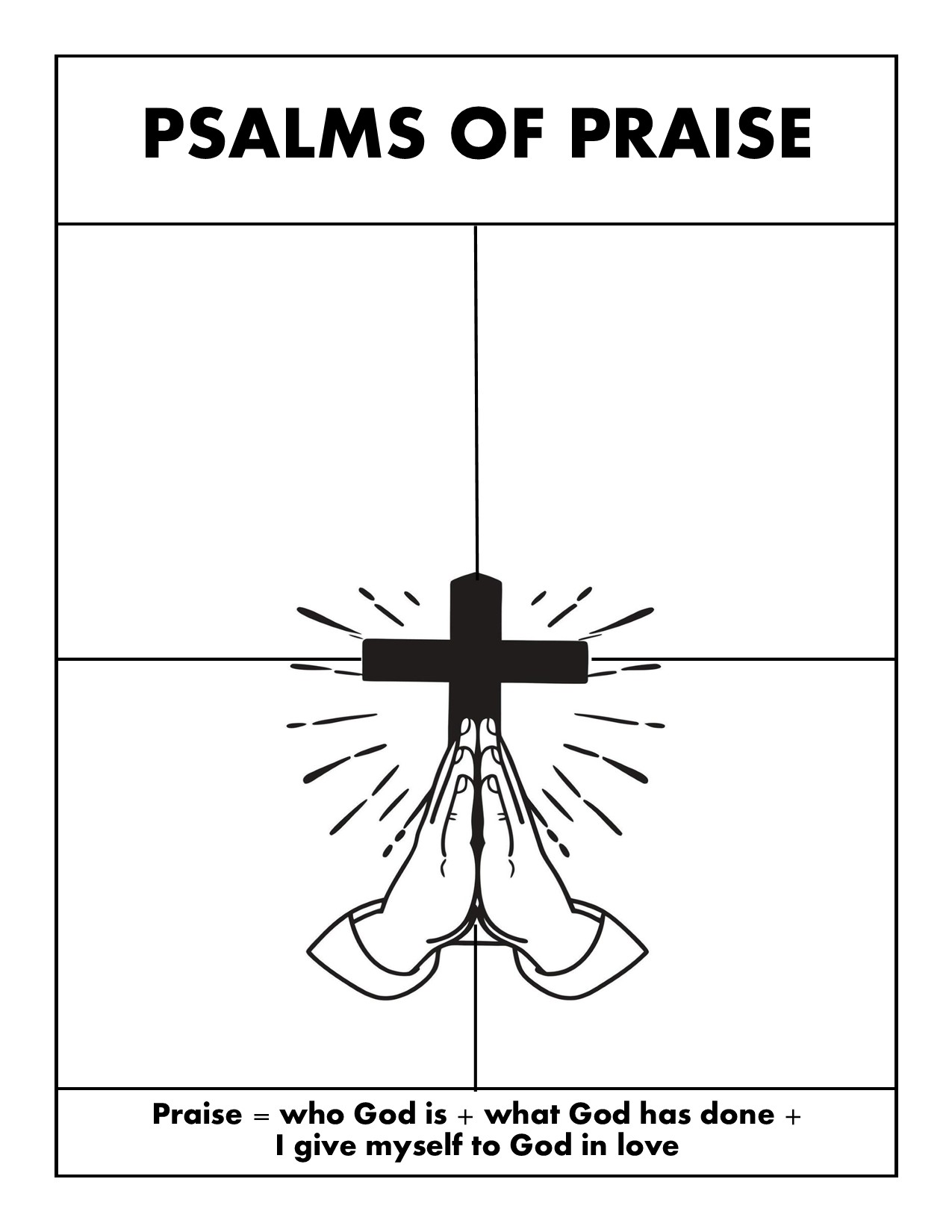
Because this series encompasses some writings that embrace several expressive art forms, I thought we would enhance our learning through some creative note taking. In a moment you will each receive a little kit, and I’ll give instructions along the way. When we sing harmonies, the notes we sing are often different from those around us. Likewise, because this is a creative exercise, the notes we take will be different from those around us, so I encourage you to be free and have some fun!
I don’t know about you, but having grown up in church, and especially having been a part of various charismatic churches, I’ve noticed that a lot of people tend to use the words “praise” and “worship” interchangeably. This often seems to be the case when speaking about the portion of a church service in which there is instrumental music and congregational singing. The apostle Paul both encourages and urges us in Romans 12:1, “I appeal to you therefore, brothers and sisters, by the mercies of God, to present your bodies as a living sacrifice, holy and acceptable to God, which is your spiritual worship.
But what does it mean to praise God? What does it mean to worship God? Jacobson offers a simple and helpful explanation that clarifies the distinction between praise and worship: “theologically, praise is both testimony (telling others who God is and what he has done) and worship (giving oneself to God in love).”
Praise = who God is + what God has done + I give myself to God in love
I don’t appreciate wooden formulas, but I want to direct you to a living and life-giving formula at the bottom of your handout. I hope that this “formula of praise” will help to remind each of us to keep our focus from drifting into less important things.
Praise = who God is + what God has done + I give myself to God in love.
To praise God is to testify to who God is, to testify to what God has done, and to give ourselves afresh to God in love.
What about worship? Let’s start with what worship is not. Worship is not limited to singing or music; as powerful as it is to pour our hearts out to God in song, music itself is not the entirety of worship. Worship is not something we do only during church services; as important as it is to gather together to worship God, meeting in a specific place on a specific day is not the entirety of worship. Worship is not about us or our emotions; as refreshing and encouraging as it is for us to experience God’s presence, worship is not about us getting our needs met.
I really like this comprehensive definition of worship from William Temple, who served as the Archbishop of Canterbury at the turn of the 20th century: “the submission of all our nature to God. It is the quickening of conscience by His holiness; the nourishment of mind with His truth; the purifying of imagination by His Beauty; the opening of the heart to His love; the surrender of will to His purpose – and all of this gathered up in adoration, the most selfless emotion of which our nature is capable and therefore the chief remedy for that self-centeredness which is our original sin and the source of all actual sin.” Borrowing from fourth century Bishop Basil the Great’s instruction on prayer, I think of worship as one continuous and uninterrupted act of devotion in which we join ourselves to God through our whole way of life.
All twenty-four Psalms of Praise were composed for use in public worship and celebration, when the community comes together to praise God. Almost all of the Psalms of Praise begin and end with a call to praise. The most common call to praise is the Hebrew hal·lū yāh, which means “Praise Yah!” which is a poetic abbreviation of “Praise YHWH!” In English translations of the Old Testament, there is a distinction between the name of God, YHWH, and the title most commonly applied to God: “LORD” in all caps designates YHWH (the four-letter name of God which highlights God’s self-existence and covenant faithfulness), whereas “Lord” with only the “L” capitalized designates Adonai (“my Lord,” used as a respectful substitute to avoid accidentally taking the divine name in vain). Other calls to praise include “Bless the LORD!” “Rejoice in the LORD!” “Make a joyful noise to God!” and “Sing to the LORD!” The important thing is that these phrases call the community of worshipers to offer both testimony and worship to God. As we gather together for public worship, we are called to together testify to who God is, to testify to what God has done, and to give ourselves afresh to God in love. For example, listen to the beginning and ending of Psalm 150: “Hallelujah! Praise God … Let every living, breathing creature praise God! Hallelujah!”
After the call to praise, the body of each Psalm of Praise consists of testimony, reasons to praise God because of who God is and what God has done. Sometimes these testimonies are in the second person (“You are great”), other times in the third person (“God is great”). For example, Psalm 145:9,13,17 – “The Lord is good to all, and his compassion is over all that he has made … Your kingdom is an everlasting kingdom, and your dominion endures throughout all generations … The Lord is just in all his ways, and kind in all his doings.”
As interesting as it is to examine the parts of the Psalms, remember that they are first and foremost sacred poems meant to be sung. Russian composer Igor Stravinsky said, “Music praises God. Music is well or better able to praise him than the building of the church and all its decoration; it is the Church’s greatest ornament.” In their Word Biblical Commentary on the Psalms, Craigie and Tate note that “somewhere between and third and a half of the OT is poetic in form … There are aspects of human experience, and aspects of the knowledge of God, for which the mundane language of prose cannot provide adequate expression … the psalms … utilize the medium of poetry to convey insight, experience, the perception of God, and the nature of the relationship with God … They are … profoundly theological writings … Poetry, like music, may be analyzed and dissected, yet ultimately it must be appreciated and experienced.”
God is the center and focus of all of the Psalms. Three primary themes emerge in the giving of testimony in the Psalms of Praise, all of which emphasize God’s faithfulness: in creation, in history, and as the King.
God is faithful in creation
The Psalms of Praise emphasize God’s faithfulness in creation. In the ancient Near East, the prevailing creation myths portrayed creation as the result of some kind of divine conflict. In sharp contrast, the Psalms of Praise describe creation as a beloved act of a faithful God. Psalm 136:2,6-7 – “O give thanks to the God of gods, for his steadfast love endures forever … who spread out the earth on the waters, for his steadfast love endures forever; who made the great lights, for his steadfast love endures forever.”
The Psalms of Praise portray creation as a place of both complexity and order. There are times, days, and rhythms that sustain all of God’s creatures, making it possible for us to live mutually with one another. Psalm 104:14,19 – “You cause the grass to grow for the cattle, and plants for people to use, to bring forth food from the earth … You have made the moon to mark the seasons; the sun knows its time for setting.”
The Psalms of Praise also portray creation as a place of beauty and wonder. In 1869 Maria Mitchell, the first female American professional astronomer observed that “every formula which expresses a law of nature is a hymn of praise to God.” A few decades later, French novelist Marcel Proust wryly remarked that “the highest praise of God consists in the denial of him by the atheist who finds creation so perfect that it can dispense with a creator.” Astrophysicist Adam Becker, in an article in MIT Technology Review, concludes that “we’re lucky—we live at a time when the universe is filled with complexity and beauty, even if we don’t fully understand why.” Whether someone chooses to credit God as the One who created all that there is out of nothingor not, there is no doubt that creation is a place of incredible complexity, order, beauty, and wonder! Whether we search with telescopes or microscopes, externally or internally, intentionally or serendipitously, God’s fingerprints indelibly touch every part of God’s beloved creation. Psalm 111:2-3 in The Message reads, “God’s works are so great, worth a lifetime of study – endless enjoyment! Splendor and beauty mark his craft; His generosity never gives out.”
The Psalms of Praise also emphasize how God sustains the cosmos. In their Bible Background Commentary, Walton, Matthew, and Chavalas note that “the praise of Yahweh as the Creator in Psalms is focused mainly on his ordering and maintenance of the cosmos. His control and his sovereignty are indicated as he shows his mastery of the heavens, clouds, sun, moon, stars, earth, seas, thunder and lightning … The poetic language of the Psalms does not hesitate to adopt the imagery of the cosmos that is common to the worldview contained in the mythology and old-world science of the ancient Near East.” Here’s a beautiful excerpt from the November 28th entry of L. B. Cowman’s Streams in the Desert: “Have you ever risen early, climbed a hill, and watched God make the morning? The dull gray gives way as He pushes the sun toward the horizon, and then the tints and hues of every color begin to blend into one perfect light as the full sun suddenly bursts into view … you can hear the music of heaven’s choir as it sings of the majesty of God Himself and of the glory of the morning. In the holy hush of the early dawn I hear a Voice – ‘I am with you all the day, Rejoice! Rejoice!’”
[That brings us to the top left quadrant on your handout – this space is for your stickers that portray God as faithful in creation.]God is faithful in history
The Psalms of Praise emphasize God’s faithfulness in history. God has been faithful throughout all history to all that God has made.
Of course, the word “history” necessarily means “human history” because God transcends time and space and has entered time and space with us humans, God’s beloved image bearers. History is the past itself, whatever has already happened.
The Psalms of Praise emphasize God’s faithfulness to all. Some, such as Psalm 105, also draw attention to the history of God’s covenant people with God, in what Jacobson describes “as the long and sad story of how Israel consistently proved unfaithful to God.” The Psalms of Praise remind us that no matter how humans act, God remains both faithful and forgiving because that is who God is. God’s essence and character remain the same forever. God is faithful in history to all people and all nations. Psalm 67:4 – “Let the nations be glad and sing for joy, for you judge the peoples with equity and guide the nations upon earth.” Psalm 117:1 – “Praise the Lord, all you nations! Extol him, all you peoples!”
We experience God’s faithfulness in history through God’s good gifts of faith, hope, and love. Remembering what God has done in the past strengthens our faith, as we celebrate God’s fulfillment of past promises, and look forward with hope in the confident and joyful expectation of the consummation of God’s restoration and reconciliation of all of creation to himself through Jesus Christ when Christ returns, and we are forever united with God by love.
[That brings us to the top right quadrant on your handout – this space is for your stickers that portray God as faithful in history.]God is faithful as the King
The Psalms of Praise emphasize God’s faithfulness through God’s Kingship over everything. Considering the context in which the Psalms were written, Walton, Matthew, and Chavalas tell us that “in the ancient Near East the role of king was attributed to the chief national god, the head of the pantheon … The rule of these gods in the divine realm was exercised over the other locally worshiped gods … In the human realm these gods would be closely identified with the human king as they were involved together in military exploits, building projects, and maintaining justice in society.” They go on to interpret for us the importance of understanding this connection, because the ultimate responsibility for everything the human king oversaw rested with the corresponding god whom he represented. The Psalms repeatedly proclaim YHWH as King, which meant that YHWH was sovereign over everything, from individual crises to national disasters to the nations and the very cosmos itself. Psalm 29:10 – “The Lord sits enthroned over the flood; the Lord sits enthroned as king forever.” Psalm 145:1 – “I will extol you, my God and King, and bless your name forever and ever.”
In their Yale Bible Study on the Psalms, Professors Collins and Baden note that “it was understood in ancient Israel, and in its Near Eastern context more broadly, that creation and justice are deeply linked: part of creating the world is establishing its firm foundations, the bedrock on which we all live and move. That bedrock is understood to be founded in justice: if there is no justice from the divine sphere, then all of existence seems to be slipping.” Psalm 96:9-10 – “Worship the Lord in holy splendor; tremble before him, all the earth. Say among the nations, ‘The Lord is king! The world is firmly established; it shall never be moved. He will judge the peoples with equity.’” Psalm 146:7-9a – “[The Lord] executes justice for the oppressed; who gives food to the hungry. The Lord sets the prisoners free; the Lord opens the eyes of the blind. The Lord lifts up those who are bowed down; the Lord loves the righteous. The Lord watches over the strangers; he upholds the orphan and the widow.”
Of course, the Psalms look forward to the time when God’s kingship, God’s rule and reign, would be realized on earth as it is in heaven. In keeping with our Vineyard Statement of Faith, we believe that “Jesus was anointed as God’s Messiah and empowered by the Holy Spirit, inaugurating God’s kingdom reign on earth, overpowering the reign of Satan by resisting temptation, preaching the good news of salvation, healing the sick, casting out demons and raising the dead.” The good news now is that because Jesus defeated all enemies – sin and suffering and sickness and death – because he conquered these enemies forever with his life and with his love, Christ Jesus now reigns as King over all. We, the church, the body of Christ, are the instrument of God’s kingdom who continue proclaiming and demonstrating the good news of this upside-down kingdom on the earth today in allegiance to Christ the King.
[That brings us to the bottom left quadrant on your handout – this space is for your stickers that portray Christ as King.]I give myself to God in love
We’ve talked a lot today about the testimony we find in the Psalms of Praise, reasons to praise God because of who God is and what God has done. Now we consider the last part of our “formula of praise,” namely, worship, the giving of ourselves to God in love. Jesus said that “God is spirit, and those who worship him must worship in spirit and truth.” We can search high and low for complicated explanations of what this means. I really like the simplicity and wisdom in quotations from two beloved 20th century saints. The first quotation comes from Scottish theologian William Barclay: “When men worship Jesus Christ, they do not fall at his feet in broken submission, but in wondering love. A man does not say, ‘I cannot resist a might like that.’ He says, ‘Love so amazing, so divine, demands my life, my soul, my all.’ A man does not say, ‘I am battered into surrender.’ He says, ‘I am lost in wonder, love, and praise.” The second quotation comes from Albanian-Indian nun and missionary Mother Teresa: “When you know how much God is in love with you, then you can only live your life radiating that love.”
May we each make a fresh commitment today to give ourselves to God in love.
[That brings us to the bottom right quadrant on your handout – this space is for your stickers that portray the giving of ourselves to God in love.]Conclusion
As we near the end of this short introduction, I want to whet your appetite by reading the first line from The Message translation of each of the eight Psalms of Praise we’ll be looking at in the next two months. You might remember that we enjoyed Beth’s and others’ wonderful reflections and songs on some of these two weeks ago during Scriptures, Songs, and Saints:
- God, brilliant Lord, yours is a household name. (Psalm 8)
- God’s glory is on tour in the skies, God-craft on exhibit across the horizon. (Psalm 19)
- Bravo, God, bravo! Gods and all angels shout, “Encore!” (Psalm 29)
- Good people, cheer God! Right-living people sound best when praising. (Psalm 33)
- Silence is praise to you, Zion-dwelling God, And also obedience. (Psalm 65)
- God, mark us with grace and blessing! Smile! (Psalm 67)
- Up with God! Down with his enemies! Adversaries, run for the hills! (Psalm 68)
- Sing God a brand-new song! Earth and everyone in it, sing! (Psalm 96)
And finally, let us sing together the 1551 hymn, “All People That On Earth Do Dwell,” with lyrics drawn from Psalm 100, a Psalm of Praise.
All People That on Earth Do Dwell (Psalm 100)
All people that on earth do dwell,
Sing to the LORD with cheerful voice.
Him serve with mirth; His praise forth tell;
Come ye before Him and rejoice.
Know that the LORD is God indeed;
Without our aid He did us make.
We are His folk; He doth us feed,
And for His sheep He doth us take.
O enter then His gates with praise;
Within His courts your thanks proclaim;
With grateful hearts your voices raise
To bless and magnify His name.
Because the LORD our God is good,
His mercy is forever sure;
His truth at times firmly stood
And shall from age to age endure.