Actions speak louder than words (reasonable? or reckless?)
Actions speak louder than words (Proverbial Sayings: Reasonable or Reckless?) – Jun 21st, 2026
We’ve been watching the FIFA World Cup this week. One of the commentators during the Argentina-Algeria game in Kansas City, Missouri noted that that stadium holds the Guinness World Record for the loudest crowd roar at a sports stadium, at 142.2 decibels. A normal speaking voice is measured around 60 decibels. When is the last time you successfully had a meaningful conversation near a blender (85 decibels), motorcycle (100 decibels), or an emergency siren or jackhammer (120 decibels)? The louder the sound, the lower the comprehension. When things are that noisy, words cannot be heard. We need something else to cut through all that noise. That brings us to this week’s phrase in our sermon series Proverbial Sayings – “actions speak louder than words.”
Of course, it’s not just the literal volume of the words that’s important. Academic linguist Gabriela Torres tells us that this idiom “is a phrase born from the timeless frustration of dealing with people who promise the moon but deliver nothing … What someone actually does is a more accurate indicator of their true intentions and character than what they say they will do. It is typically used when someone’s behavior contradicts their statements, or to emphasize that concrete results are more valuable than vague promises.” She points to the New Testament as the source of this proverbial saying:
1 John 3:16-18 – “We know love by this, that [Jesus Christ] laid down his life for us—and we ought to lay down our lives for one another. How does God’s love abide in anyone who has the world’s goods and sees a brother or sister in need and yet refuses help? Little children, let us love, not in word or speech, but in truth and action.”
Many centuries later, Michel de Montaigne, a 16th century French philosopher, put the same idea this way, “Saying is one thing and doing is another.” English clergyman Thomas Draxe expressed it more poetically in 1616: “Deeds are fruits, words are but leaves.” Torres tells us that in 1731 the proverbial phrase turned into a political weapon used to demand accountability when it appeared in a document concerning political and economic strife in colonial Massachusetts, The Melancholy State of this Province. The idiom gained massive traction after President Abraham Lincoln famously spoke it in 1856, in the post-industrial revolution era which highly valued efficiency and results.
I think this proverbial saying is completely reasonable, and there is no better example of this proverb in all of literature than in Jesus’ Parable of the Good Samaritan.
Luke 10:25-37 – “a lawyer stood up to test Jesus. ‘Teacher,’ he said, ‘what must I do to inherit eternal life?’ He said to him, ‘What is written in the law? What do you read there?’ He answered, ‘You shall love the Lord your God with all your heart, and with all your soul, and with all your strength, and with all your mind; and your neighbor as yourself.’ And he said to him, ‘You have given the right answer; do this, and you will live.’ But wanting to justify himself, he asked Jesus, ‘And who is my neighbor?’ Jesus replied, ‘A man was going down from Jerusalem to Jericho, and fell into the hands of robbers, who stripped him, beat him, and went away, leaving him half dead. Now by chance a priest was going down that road; and when he saw him, he passed by on the other side. So likewise a Levite, when he came to the place and saw him, passed by on the other side. But a Samaritan while traveling came near him; and when he saw him, he was moved with pity. He went to him and bandaged his wounds, having poured oil and wine on them. Then he put him on his own animal, brought him to an inn, and took care of him. The next day he took out two denarii, gave them to the innkeeper, and said, “Take care of him; and when I come back, I will repay you whatever more you spend.” Which of these three, do you think, was a neighbor to the man who fell into the hands of the robbers?’ He said, ‘The one who showed him mercy.’ Jesus said to him, ‘Go and do likewise.’”
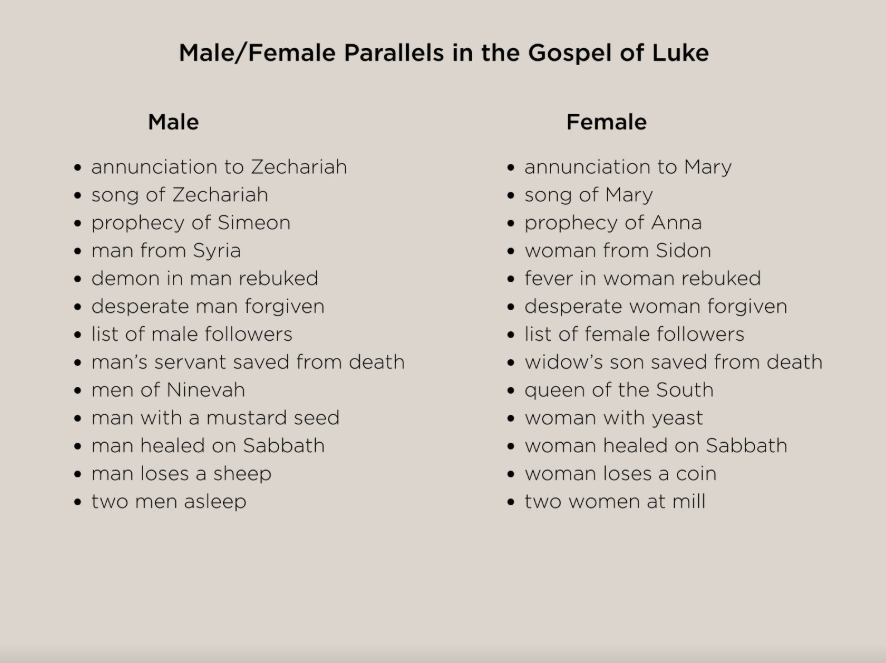
I want to highlight a contextual detail that is easy to miss when reading the Gospel of Luke in bite-sized portions. It’s important to understand that although all four gospel writers emphasize the inclusion of all people in the good news of the kingdom of God that Jesus proclaimed and demonstrated, Luke goes even further by doing something that was just as revolutionary. Pastor and biblical scholar, R. Herbert, points out that Luke “carefully arranges his Gospel to include a woman at every key point in the narrative in which a man is found.” It’s fascinating to discover these intentional pairings, and I’m including a chart with the recording of today’s sermon. Cuban-American historical theologian Justo L. González notes that in the pairing of the parable of the Good Samaritan with the visit of Jesus to the home of Mary and Martha, both passages “exalt someone who does the unexpected … both passages show that these people, a Samaritan and a woman, whose ability to be true disciples and followers of the Law might be doubted, are the ones who really understand and practice what God wills for them.”
Today, we are going to look at four actions in this familiar parable to which Jesus calls us that all speak far louder than any words we say. Thinking about the loudness of noises reminds me of a word we use to describe the sudden loud noise made by fireworks, gunshots, or sonic booms, “BANG!” Yep, today’s sermon is brought to you by the acronym B-A-N-G! I want to invite us to imagine fresh ways to put into practice these actions to which Jesus calls us:
B: The first action to which Jesus calls us is to Begin and end with love
Jesus commends the lawyer for correctly answering his question about what the law says about inheriting eternal life – “You shall love the Lord your God with all your heart, and with all your soul, and with all your strength, and with all your mind; and your neighbor as yourself.” 1 John 4:19 reminds us that “we love because God first loved us.” God’s love is unconditional, sacrificial, eternal, and self-giving. Ephesians 2:13-16 points to the universal quality of God’s love, for all people – “[Christ Jesus] has abolished the law with its commandments and ordinances, that he might create in himself one new humanity in place of the two [Jews and non-Jews], thus making peace, and might reconcile both groups to God in one body through the cross, thus putting to death that hostility through it.”
Let us consider how we can respond to Jesus’ call to love in our own time and place. We cannot give what we have not yet received. I invite you to receive more of the unconditional, sacrificial, eternal, and self-giving love of God as I lead us in a prayer from Bible teacher J. D. Walt, “Prayer of First Love.”
Jesus, I belong to you. I am no longer my own, but yours. You are my Lord and my God. I give you my complete, undivided, and whole-hearted attention. I give you my desires and affections and only receive them back as they have been granted by you.
I receive from you the mind of Christ … to think as you think, to imagine as you imagine, to ponder as you ponder, your curiosities, your impressions, your insights, your joys, your sadnesses, your longings, your loves. My work will find its origin and fulfillment in the gifts, talents, skills, and creativity you have entrusted to me.
Jesus, I belong to you. Henceforth, Your vision will be my sight; Your word, my food; Your Spirit, my breath; Your resurrection, my power; Your suffering, my fellowship; Your Kingdom, my ambition; Your people, my passion; Your love, my life.
Jesus, I belong to you. I covenant with you the following exchanges: My emptiness—for your fullness; My brokenness—for your wholeness; My sin—for your righteousness; My guilt—for your pardon; My lust—for your longings; My drunkenness—for your sobriety; My shame—for your glory; My pride—for your humility; My thirst for fame—for your desire for holiness; My striving—for your rest; My impossible burden—for your easy yoke.
Jesus, I belong to you. You are to me: the Word made flesh; the image of the invisible God; the exact representation of his being; the first fruits of the Resurrection; the bright and morning star; the Ancient of Days; the Son of God and the Son of Man; the Bread of Heaven; the True Vine; the Way and the Truth and the Life; the Resurrection; the Light of the World; the Good Shepherd; the Lamb of God who takes away the sins of the world; the Lamb slain from before the foundation of the world; the Messiah, the Savior; the Lord of Heaven and Earth.
Jesus, I belong to you. By your commission I am called. By your calling I am chosen. In your communion I am consecrated. Through your fullness I am overflowing. In your holy love I am joyfully alive.
Jesus, I belong to you. In the name of the Father, and the Son, and the Holy Spirit, Amen.
A: The second action to which Jesus calls us is to Admit our own prejudices with humility
González points out that “the setting of the parable is a warning on the misuse of theology” in which the lawyer, who is well aware of what God requires, “uses theological debate as a means to avoid obedience.” Certainly the lawyer, being an expert in the Jewish Law, knew the heart of the Law, Micah 6:8, “He has told you, O mortal, what is good; and what does the Lord require of you but to do justice, and to love kindness, and to walk humbly with your God?”
The main stumbling block Jesus highlights in his response to the lawyer has to do with prejudice. In our day, the word “Samaritan” has come to mean “a person who is generous in helping those in distress.” But for Jesus’ original hearers, the word carried a lot of negative baggage. New Testament scholar N. T. Wright tells us that “the hatred between Jews and Samaritans had gone on for hundreds of years – and is still reflected, tragically, in the smoldering tension between Israel and Palestine today. Both sides claimed to be the true inheritors of the promises to Abraham and Moses; both sides, in consequence, regarded themselves as the rightful possessors of the land.”
New Testament Professor Diane G. Chen notes that the lawyer’s second question betrays his questionable motive. She concludes that “the lawyer is hiding behind the law to justify his unneighborly attitude,” because “implicit in ‘Who is my neighbor?’ is the opposite question, ‘Who is not my neighbor?’” In their Wisdom Commentary, Barbara Reid and Shelly Matthews note that “at the end of the parable, Jesus … inverts the scholar’s question; ‘who is my neighbor?’ is turned around: ‘who became neighbor to the victim?’” Wright notes that the lawyer’s question “does indeed produce from Jesus an answer about the wide-reaching grace of God, but the story Jesus tells makes it clear that these views are not heretical but rather the true fulfillment of the commandment which the lawyer claims to regard as vital.”
Let us consider how we can respond to Jesus’ call in our own time and place. Organizational psychologist Dr. Tomas Chamorro-Premuzic says that “prejudice, a derogatory attitude or antipathy based upon unfair generalization, runs deeply in the human psyche.” He states that everyone is prejudiced, going as far as to say, “to be human = to be biased by design.” However, some people are more biased than others. So, the challenge for us is to admit our prejudices with humility.
I invite you to together confess our sins of prejudice, which results in a lack of love, to God in this prayer of confession by Pastor Fran Pratt:
God, I have sinned against you in thought, and word, and deed; in things I have done, but mostly in things I have left undone. I have not loved you with my whole heart. I have not loved my neighbor as I love myself. Half the time, I haven’t even realized my neighbor was there. You were thirsty and I didn’t give you a drink. You were naked and I didn’t clothe you. I have gone around blind, preoccupied, self-absorbed, lazy, prideful. I have blamed it on family responsibilities, lack of time, not my problem, my smallness, fear of doing it wrong. If compassion is a seed, then I am the thorny soil.
Forgive me, Oh God, according to your mercy. According to your great compassion, blot out all my iniquity. I have nothing to offer you except a broken and contrite heart. Remake my heart out of love, and let love be the heart of my life.
Amen.
N: The third action to which Jesus calls us is to Notice others in need with empathy
Jesus tells us in this parable that the priest (and the Levite), who both saw the man who had been robbed, were among those who served to mediate between God and the people. They were both guided by the “golden rule,” “you shall love your neighbor as yourself” (Leviticus 19:18) and to love resident aliens in exactly the same way (Leviticus 19:34).
New Testament Professor Craig Keener points out that “completely stripping [the victim] treated him like a corpse on a battlefield” because clothes were a valuable item to steal. In that state, it would have been difficult to tell if he was dead or alive. Chen adds that this created a dilemma for the priest and the Levite: “If the man were dead or should he die in their care, they would contract corpse impurity. The priest and the Levite both pick the safer course of action. They would rather give the severely injured man a wide berth than risk coming into contact with a dead body. Motivated by self-preservation while using the law of purity as justification, their inaction speaks volumes about their religious and moral priorities.”
The ironic thing about their choices is that there was no scriptural reason why either of them needed to avoid ritual defilement, rules that applied only to their Temple duties because they were “going down” from Jerusalem, away from Jerusalem. N. T. Wright bluntly interprets the Temple officials’ choices, “It was better that they remain aloof, preserving their purity at the cost of their obedience to God’s law of love.” They definitely noticed the half-dead traveler in need. But they chose to avoid and ignore him, to look away. By choosing to detour around the victim, they compounded his trauma.
The Samaritan also notices the half-dead traveler in need. By choosing to respond with empathy, the Samaritan becomes the conduit of grace through whom God’s healing began to flow. Biblical scholar Elizabeth Dowling draws our attention to God’s mercy in the Samaritan’s actions, which are “extravagant rather than perfunctory, and the wider Earth community (through the agency of the oil, wine, bandages, animal, and innkeeper …) contributes to this spiraling response of mercy and healing.”
Let us consider how we can respond to Jesus’ call in our own time and place. Jesus calls us away from academic labeling (“Who is my neighbor?” “Who is not my neighbor?”) and into active love (“To whom can I be a good neighbor?”) What situation involving a person or group does God want me to notice with empathy? How can I turn toward those in need instead of looking away?
G: The fourth action to which Jesus calls us is to Go and do with mercy
Chen notes that the Samaritan “is [also] subject to the law concerning corpse impurity, but moved by compassion, he chooses to stop and tend to the victim’s wounds … acts of justice and mercy are costly, and it is much easier to pretend not to notice – or, worse, to stand and stare but not say a word or lift a finger. From the human point of view, the Samaritan has everything to lose and nothing to gain by helping the injured man, yet he exemplifies the risk-taking mercy that characterizes both Jesus and God.”
The mercy of God is not limited by “charity begins at home,” “blood is thicker than water,” or “our nation first.” There is nothing wrong with being proud of our ethnic, cultural, national, or religious identity. All over the world, people are proud of these things, no matter where we are from or how old our family is. We can easily see this in sports competitions such as the FIFA World Cup. But Jesus shows and tells us that the primary identity of all men, women, and children is that of image bearers of God. No one is excluded from Jesus’ kingdom program. As we talked about last week, while human institutions draw lines, Jesus erases them. Mother Teresa frequently referred to serving the poor, the sick, and the outcast as encountering “Jesus in his most distressing disguises.” Dowling notes that we, alongside Jesus’ original hearers that day, “are encouraged to be an active part of the Earth community that generously unites to respond to the pain of the world.”
The Old Testament holiness code says, “be holy, for I am holy” (Leviticus 11:45). We hear echoes of this in the Gospel of Luke which speak directly to God’s heart of mercy that we are to imitate. Luke 6:31, 35-36 – “Do to others as you would have them do to you … love your enemies, do good, and lend, expecting nothing in return. Your reward will be great, and you will be children of the Most High; for he is kind to the ungrateful and the wicked. Be merciful, just as your Father is merciful.” DeSilva notes that “whereas Matthew has restated this command using the terminology of wholeness – ‘Be perfect, therefore, as your heavenly Father is perfect” (Matthew 5:48), Luke has rewritten it to highlight God’s mercy as the central characteristic of God that is to be reflected in the people of God … Luke provides a model for how Jesus’ disciples are to look on those who are designated outsiders, who are ‘not our kind,’ who live on the ‘wrong side’ of some set of tracks by the standards of ethnicity, religion, nationality, or sexual orientation … As we continue to heed God’s call to bring his salvation to all, we are challenged boldly to cross those humanly drawn boundaries in outreach and not to look on each person through the lens of any human prejudice or to respond to them in kind when they speak to us out of their prejudice but to seek their redemption in God’s love.” Wright gets to the heart of the matter, “What is at stake, then and now, is the question of whether we will use the God-given revelation of love and grace as a way of boosting our own sense of isolated security and purity, or whether we will see it as a call and challenge to extend that love and grace to the whole world.”
To quote one of my favorite hymns, written by Frederick William Faber: “There’s a wideness in God’s mercy like the wideness of the sea; there’s a kindness in His justice which is more than liberty. For the love of God is broader than the measure of our mind; and the heart of the Eternal is most wonderfully kind.”
Let us consider how we can respond to Jesus’ call in our own time and place. When we pray “Lord, have mercy” and “Kingdom of God, come, on earth as it is in heaven,” will we rise to the occasion when our prayers are answered?
Conclusion
Words, words, words. Words are the currency of modern algorithms and daily commerce. We are drowning in words through a continuous stream of text messages, social media posts, and news alerts. We are bombarded with catchy phrases and slick slogans from corporations and causes alike. We are lost in cacophonous linguistic jungles from data-driven artificial intelligence. Jesus knew that words were not enough because actions speak louder than words. Whenever we, the church, become aware of injustice, poverty, hunger, oppression, or persecution, we must not remain on the safe side of the road. We must do something about it. We are not called to fix the world. We are called to love the world. We demonstrate love for the world through small acts of great love, freely giving in specific situations of need whatever we have received from the good hand of God, in the name of Jesus, and by the power of the Holy Spirit. Actions do speak louder than words. May we together go and bear fruit, fruit that will last, for the kingdom and glory of God!