Better late than never (reasonable? or reckless?)

Better late than never (Proverbial Sayings: Reasonable or Reckless?) – Jun 14th, 2026
Remember me. Unfortunately, these days, we may most often encounter these two words next to a checkbox to save our login credentials so we don’t have to type in our password every time we visit that website. A much more beautiful and helpful descriptor comes to us from Frederick Buechner, “When you remember me, it means you have carried something of who I am with you, that I have left some mark of who I am on who you are. It means that you can summon me back to your mind even though countless years and miles may stand between us. It means that if we meet again, you will know me.”
Christina Rossetti’s 1862 poem Remember poignantly opens with, “Remember me when I am gone away, gone far away into the silent land; when you can no more hold me by the hand.” In 1952, radio singing cowboy Stuart Hamblen wrote and recorded (Remember Me) I’m the One Who Loves You. The song Remember Me is the emotional centerpiece of the 2017 animation Coco: “Remember me though I have to say goodbye. Remember me. Don’t let it make you cry. For, even if I’m far away, I hold you in my heart. I sing a secret song to you each night we are apart.”
But I think the most profound use of these two words happened 2000 years ago. As we continue our current sermon series, Proverbial Sayings, today we are considering a phrase that could well have been spoken in response to these two words.
Each of the four New Testament gospels, in their accounts of Jesus’ crucifixion, mentions two other people who were crucified with him. As the Gospel Project says, “while all four Gospels tell the same story of Jesus’s life, death, and resurrection, each author writes from a distinct theological perspective to emphasize a unique aspect of His identity and mission.”
John’s gospel emphasizes Jesus as the eternal word who became flesh. John 19:18 – “There they crucified him, and with him two others, one on either side, with Jesus between them.”
Matthew’s gospel emphasizes Jesus as the long-awaited and promised Messiah and rightful King. Matthew 27:37-38 – “Over his head they put the charge against him, which read, ‘This is Jesus, the King of the Jews.’ Then two bandits were crucified with him, one on his right and one on his left.”
Mark’s gospel emphasizes Jesus as the suffering servant and Son of God who came to give His life as a ransom for humanity. Mark 15:26-27,32b – “The inscription of the charge against him read, ‘The King of the Jews.’ And with him they crucified two bandits, one on his right and one on his left … Those who were crucified with him also taunted him.”
Luke’s gospel emphasizes Jesus as the compassionate Savior for all nations who came to seek and to save the lost. Luke 23:32-34,39-43 – “Two others also, who were criminals, were led away to be put to death with him. When they came to the place that is called The Skull, they crucified Jesus there with the criminals, one on his right and one on his left. [Then Jesus said, ‘Father, forgive them; for they do not know what they are doing.’] … One of the criminals who were hanged there kept deriding him and saying, ‘Are you not the Messiah? Save yourself and us!’ But the other rebuked him, saying, ‘Do you not fear God, since you are under the same sentence of condemnation? And we indeed have been condemned justly, for we are getting what we deserve for our deeds, but this man has done nothing wrong.’ Then he said, ‘Jesus, [mnēsthēti mou] remember me when you come into your kingdom.’ He replied, ‘Truly I tell you, today you will be with me in Paradise.’”
It is very possible that someone standing near the three crosses that day who overheard this astounding conversation could well have remarked, “Better late than never!” Yes, that is the phrase we are considering today as we continue our current sermon series, “Proverbial Sayings: reasonable? or reckless?” “Better late than never” has been used for well over 2000 years, since before Jesus was born, with the earliest recorded usage appearing in Livy’s History of Rome in 27 BC – “potiusque sero quam nunquam.”
Who were these two men crucified on either side of Jesus? Matthew and Mark call them bandits, léstés, the same word Jesus uses on at least three other occasions: in his Parable of the Good Samaritan; in his cleansing of the Temple; and at his arrest in the Garden of Gethsemane. Léstés describes violent bandits or revolutionaries. However, Luke, in his gospel, opts for the Greek word kakourgos, a broader term meaning any worker of evil.
The man who asks Jesus to “remember me when you come into your kingdom” is known as the penitent thief and often named Dismas. He is memorialized in the names of churches, ministries, and prayers, and in countless works of art, literature, music, drama, film, and even games.
What can we learn about who God loves and how we receive salvation from this short yet surprising conversation on the crosses? As I like to do, let’s consider what Jesus did not say to Dismas:
“One of the criminals who were hanged there kept deriding him and saying, ‘Are you not the Messiah? Save yourself and us!’”
Jesus replied, ‘Well, I could, but I’m not going to. You’ve already used up the last of your chances!’”
No, that is not what God is like. Lamentations 3:23-24 assures us that “the steadfast love of the Lord never ceases, his mercies never come to an end; they are new every morning; great is your faithfulness.” Jesus said in John 3:16, “For God so loved the world that he gave his only Son, so that everyone who believes in him may not perish but may have eternal life.” God doesn’t just give second chances. It’s even better than that! God gives second, third, fourth, hundredth, thousandth, millionth, and zillionth chances!
It is impossible for us to use up all of our chances because the steadfast love of the Lord never ceases, God’s mercies never come to an end! God gives eternal life to everyone who believes in Jesus.
Let’s try that again. “‘Are you not the Messiah? Save yourself and us!’ But the other rebuked him, saying, ‘Do you not fear God, since you are under the same sentence of condemnation? And we indeed have been condemned justly, for we are getting what we deserve for our deeds, but this man has done nothing wrong.’ Then he said, ‘Jesus, remember me when you come into your kingdom.’
Jesus replied, ‘Your friend here has a point. You are just getting what you deserve. I haven’t done anything to you – you’ve done this to yourself through your own poor choices. You should have repented a long time ago. You are simply too late.”
No, that is not what God is like. Psalm 103:8-10 tells us that “The Lord is merciful and gracious, slow to anger and abounding in steadfast love. He will not always accuse, nor will he keep his anger forever. He does not deal with us according to our sins, nor repay us according to our iniquities.” Maybe it was as Dismas saw how Jesus endured completely undeserved torture and humiliation with complete forgiveness and grace that he realized that Jesus was no ordinary human. Certainly, God gave Dismas a profound revelation of faith and repentance. And Dismas responded to the grace of God by crying out, “Jesus, remember me!” Despite a lifetime of wrongdoing, Dismas’s last-minute repentance and faith in Jesus encapsulates ultimate hope and secures his salvation. God, the great “I am,” is fully present in every moment that has ever or will ever occur because God is Lord of all, including time. 2 Corinthians 6:2b tells us, “See, now is the acceptable time; see, now is the day of salvation!” Ephesians 2:8-9 assures us, “For by grace you have been saved through faith, and this is not your own doing; it is the gift of God—not the result of works, so that no one may boast.” James 1:5 assures us that God “gives to all generously and ungrudgingly.” We are not powerful enough to change who God is!
No matter how late in life someone surrenders to the Lordship of Christ, God is present in perfect goodness, grace, and generosity, which do not depend on our choices or our actions.
Worship pastor Justin Tamlin assures us that “it does not matter whether you have failed a thousand times and find yourself now in the sunset of your life – it is never too late to begin again in God’s grace no matter how far the hands of time have turned. The power of God’s grace is so powerful that it is able to rip to shreds your muttering words … We can so easily mutter, ‘Why bother? I should have started earlier; the window of opportunity has closed!’ … it is not too late! … you can’t change the past, but God’s Spirit can change your future! … Stubborn grumpy hearts mutter: Better never than late! But a gracious loving God calls back: Better late than never!”
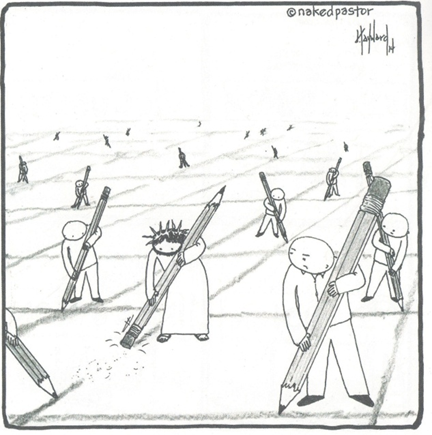
The promise that “you will be with me in Paradise” is for all who entrust themselves to Jesus. Legalistic religion focuses on rules, checklists, separation, exclusion, power, and control. Jesus’ ministry was, is, and always will be defined by radical inclusion, amazing grace, and the tearing down of dividing walls. While human institutions draw lines, Jesus erases them. I’ve included on your handout a cartoon by pastor and artist David Hayward that powerfully illustrates this. I invite you to reflect on Jesus’ radical love as I read Galatians 3:23-28 – “Now before faith came, we were imprisoned and guarded under the law until faith would be revealed. Therefore the law was our disciplinarian until Christ came, so that we might be justified by faith. But now that faith has come, we are no longer subject to a disciplinarian, for in Christ Jesus you are all children of God through faith. As many of you as were baptized into Christ have clothed yourselves with Christ. There is no longer Jew or Greek, there is no longer slave or free, there is no longer male and female; for all of you are one in Christ Jesus.”
Although we humans try to scheme and strategize and make excuses and put things off, in the end, God is always eager to work with us and help us find our way back home. Augustine of Hippo, in his fourth century autobiography, Confessions, famously wrote concerning his long spiritual and psychological struggle, “You have made us for yourself, and our hearts are restless until they find rest in you … Late have I loved you, O Beauty ever ancient, ever new, late have I loved you!” To which we gratefully concur, “Better late than never!”
Let’s consider some other ways in which “better late than never” might crop up. Some of our granddaughters’ favorite books are Arnold Lobel’s Frog and Toad stories. Picture the scene as I read, Tomorrow.
Toad woke up. “Drat!” he said. “This house is a mess. I have so much work to do.” Frog looked through the window. “Toad, you are right,” said Frog. “It is a mess.” Toad pulled the covers over his head.
“I will do it tomorrow,” said Toad. “Today I will take life easy.”
Frog came into the house. “Toad,” said Frog, “your pants and jacket are lying on the floor.” “Tomorrow,” said Toad from under the covers. “Your kitchen sink is filled with dirty dishes,” said Frog.
“Tomorrow,” said Toad. “There is dust on your chairs.” “Tomorrow,” said Toad. “Your windows need scrubbing,” said Frog. “Your plants need watering.” “Tomorrow!” cried Toad. “I will do it all tomorrow!”
Toad sat on the edge of his bed. “Blah,” said Toad. “I feel down in the dumps.” “Why?” asked Frog.
“I am thinking about tomorrow,” said Toad. “I am thinking about all of the many things that I will have to do.” “Yes,” said Frog, “tomorrow will be a very hard day for you.” “But Frog,” said Toad, “if I pick up my pants and jacket right now, then I will not have to pick them up tomorrow, will I?” “No,” said Frog. “You will not have to.” Toad picked up his clothes. He put them in the closet.
“Frog,” said Toad, “if I wash my dishes right now, then I will not have to wash them tomorrow, will I?” “No,” said Frog. “You will not have to.”
Toad washed and dried his dishes. He put them in the cupboard.
“Frog,” said Toad, “if I dust my chairs and scrub my windows and water my plants right now, then I will not have to do it tomorrow, will I?” “No,” said Frog. “You will not have to do any of it.” Toad dusted his chairs.
He scrubbed his windows. He watered his plants.
“There,” said Toad. “Now I feel better. I am not in the dumps anymore.” “Why?” asked Frog.
“Because I have done all that work,” said Toad. “Now I can save tomorrow for something that I really want to do.” “What is that?” asked Frog. “Tomorrow,” said Toad, “I can just take life easy.” Toad went back to bed. He pulled the covers over his head and fell asleep.
Procrastination – we’ve all been there! I so relate to Toad’s feeling “blah” and “down in the dumps” because of his procrastination. Of course, not every delay or postponement is procrastination. It’s only procrastination when we unnecessarily delay or postpone something in spite of negative consequences for doing so. When Toad actually did the work he had unnecessarily delayed, he was free to do what he really wanted to do. “Better late than never” seems like a reasonable response to Toad! We might also add, “next time, don’t delay!”
Our choice to procrastinate is a choice to unnecessarily give up some of our freedom.
Jesus’ great commandment comes down to loving God with all we’ve got, and loving others as well as we love ourselves. To love is to will the good of the other. So, to obey Jesus’ great commandment means choosing to will, to want, and to work towards what will bring glory to God and good to people (including myself). Whenever we realize that we are procrastinating something, there are two simple questions we might ask ourselves to discern if “better late than never” is a loving choice in that situation.
Are the negative consequences of my procrastination harmful to myself or others? What more loving choice could I make instead?
It’s so easy to procrastinate, isn’t it? I am guilty of procrastinating many things over many years in my own life, like clearing clutter or doing better self-care because life just gets overwhelming at times. I want to share one simple, practical tip today that I find to be helpful. I’m working on this, too, and have a long way to go! Being in Ohio this week reminded me of American financial executive Bob Pozen’s “OHIO principle” acronym:
OHIO = Only Handle It Once
The core idea is to deal with an item or task immediately rather than setting it aside to revisit later. The ultimate goal of applying the OHIO principle is less stress and more calm. Motivational speaker, author, and “recovering procrastinator” Rita Emmett offers us the same lesson we learned from Toad, that “the dread of doing a task uses up more time and energy than doing the task itself.”
One danger with living by a phrase like “better late than never” is that it suggests an extreme response to life’s circumstances. Since it’s been around for over 2000 years, this phrase is pretty deeply ingrained, whether spoken sincerely or with sarcasm. The way this phrase is worded, it sounds like we have only two options: late, or never. It seems unnecessary and overly dramatic to me, especially since the word “never” tends to suck all the wind out of our motivational sails, doesn’t it! “I’ll never save up to buy this thing I really want, so I might as well put it on yet another credit card.” “I’ll never lose those 20 pounds, so I might as well eat the rest of the Oreos.” We’ve all been there. And it’s not helpful!
Now, there are certainly situations in which it would be downright reckless to say or live by “better late than never.” In life-and-death emergencies or other high priority time-critical situations, it is reckless to delay responding immediately. In situations where a delay in keeping our promise is likely to damage trust, instead of just making an excuse, it would be better to do something, even a small thing, immediately, in order to demonstrate good faith, even if we cannot completely fulfill our promise. In situations involving teamwork, it is reckless to wait until later if my lateness causes everyone else additional stress or more work.
Better to act immediately in situations in which time, trust, or teamwork is the most important factor.
It seems more reasonable to add a couple of alternatives, instead of confining ourselves to only two options: “late” or “never.” Let’s have some fun with this, as we play a few rounds of Procrastination: Now-Soon-Later-or-Never (not available in stores lol). I’ll describe a scene that you might find yourself in. Feel free to think about a specific situation in your life. Then you respond by shouting out “now,” “soon,” “later,” or “never,” according to when you think is a good time to start doing something about it in order to fulfill Jesus’ great love commandment. Since I am not giving you the context for any given scenario, there may not be a single “correct” answer. Context is always key, and we do not all have the same contexts and pre-conditions!
“I still have a couple of towels in the closet, so I can wash that pile on the floor on Friday.”
“I’ll worry about filing my taxes on tax day!”
“When I think about my debt, I need a little retail therapy to destress.”
“I haven’t had my annual physical for ten years … I’m scared of what the doctor might find.”
“Half of my unread emails need a longer reply, I’ll get to them on the weekend.”
“I didn’t have time to exercise today. I’ll do a double workout tomorrow to make up for it.”
“I’m feeling sleepy, but I’ll watch just one more episode.”
“This isn’t a good time to have that tough conversation. I’ll bring it up when things settle down a bit.”
The reality is that taking positive action now or even soon, whether it involves doing even a seemingly small action or just showing up, even if it’s behind schedule, is preferable to delaying unnecessarily, not trying, or giving up.
Better to take baby steps sooner than to put things off indefinitely.
I want to mention how “better late than never” might apply to broken relationships. When we moved my Dad into assisted living around the corner at Atria, even though there were definitely hard times helping him through his medical and financial challenges and dementia, it was honestly such a blessing to have him close by. We chose to show up for Dad every day that we were in town, sometimes twice a day. One of the mixed blessings of dementia is the loss of inhibitions, and Dad softened so much in his final months. For the first time in my life, Dad expressed his love and gratitude with both words and tears. And he was able to receive my expressions of love and gratitude for him, too. I got to know my Dad in a whole new way, and I am forever grateful! “Better late than never” isn’t a perfect fit for the previous six decades during which I longed for a closer relationship with my father. But it is reasonable in describing the healing balm of God’s comforting, restorative grace.
Of course, not all of our efforts to love others are received, let alone with gratitude. Not all attempts to mend relationships go well. I have far more stories in my life about broken relationships and the inevitable trail of devastation that accompany those. As followers of Jesus on the way of love, we are called to love as God loves, expecting nothing in return. It’s good to remind ourselves and one another that we can control only our own choices, not the choices of others. The key is to keep our hearts open to God’s love and to freely give away the love we have received by putting love in action to both ourselves and others. We are not commanded to trust others who are untrustworthy. And it’s not our fault if someone else refuses to receive the love we give. But it’s on us if we fail to love. I don’t think any of us want relational resumes where our role is described as, “too little, too late.” May the epitaphs on our graves simply read, “she loved,” “he loved.”
Better to love and forgive others as Christ has loved and forgiven us.
Lord Jesus Christ, remember me!
Better Late Than Never
“Jesus, remember me” (Luke 23:42).
It is impossible for us to use up all of our chances because the steadfast love of the Lord never ceases, God’s mercies never come to an end! God gives eternal life to everyone who believes in Jesus.
No matter how late in life someone surrenders to the Lordship of Christ, God is present in perfect goodness, grace, and generosity, which do not depend on our choices or our actions.
Our choice to procrastinate is a choice to unnecessarily give up some of our freedom.
Are the negative consequences of my procrastination harmful to myself or others? What more loving choice could I make instead?
OHIO = Only Handle It Once
Better to act immediately in situations in which time, trust, or teamwork is the most important factor.
Better baby steps sooner than putting things off indefinitely.
Better to love and forgive others as Christ has loved and forgiven us.